The Evidence of Providence
Part 1: An Apprentice’s Journey in Apartheid South Africa
By Samuel
👇 Click to translate:
In Part 1 of this reflective personal memoir titled “The Evidence of Providence,” Samuel recounts his journey starting as a Coloured youth in 1970 Apartheid Durban, South Africa, guided by faith.

At the center of the human spirit lies a deep-seated belief that defines our existence: the realization and acceptance of God as the pre-existent Creator and Sustainer of all creation, visible and invisible. The story I am about to share is a remarkable testament to the evidence of divine providence. It is just one of many moments from a wonderful life—one I truly didn’t deserve, yet was graciously given.
My story begins at the end of my high school years in South Africa. During that final year—known as Matric—we had a weekly class called Career Guidance. As a young man classified under the apartheid regime’s “Coloured” racial group, our options in industry were severely restricted. Job reservation laws reserved skilled trades and major professions for the ruling white European minority. The few non-white individuals whose parents could afford tertiary education mostly became doctors or lawyers. From our community’s perspective, most men entered the building trades as carpenters, bricklayers, and plumbers, or joined the expanding field of mechanical engineering as welders, boilermakers, and pipefitters. The “clever” ones became teachers.
One day, a teacher distributed career preference forms in our classroom. On mine, I wrote two choices: Boilermaker and Engineer. I had little direct exposure to these fields, except for a few local welders mentioning that boilermakers were highly respected tradesmen with strong earning potential. I had also read brief articles about engineers designing oil refineries and bridges, which deeply intrigued me.
The Unplanned Opportunity
In January 1970, I received my Matric results: I had passed. Now came the hard part—finding a job. A friend’s older brother was an apprentice boilermaker at an engineering firm called James Brown & Hamer, located in the Durban Bay area. He planned to take my friend for an interview on Monday morning. At the time, I had no idea his brother was an apprentice, nor did I know where the company was or how to get there. I arranged to meet the brothers at the bus terminus at 6:00 AM on Monday. To this day, I remember that fateful morning: January 12, 1970.
When we arrived, we were escorted to the Boiler Shop Manager’s office. About thirty eager young men were already waiting inside the large room. Most had obtained interviews through family already working in the plant. I was the lone outsider, having tagged along with my friend.
The assistant manager conducting the interviews soon announced that all twelve apprentice boilermaker positions had been filled, though a few spots remained for welding apprentices. Looking at my Matric results certificate, he offered me one of the welding slots. He was visibly taken aback when I politely declined, explaining that I was only interested in a boilermaker apprenticeship. As he returned my certificate, he said, “Sorry, all those spots are taken.”
At that moment, the Works Manager walked into the office. Overhearing our exchange, he asked to look at my certificate. After a glance, he turned to his assistant and said, “Add him to the list as number thirteen.” I was both elated and profoundly relieved; I thanked them sincerely.
A Cold Start and a Chosen Mentor
While the welding apprentices were led to the welding shop, the boilermaker apprentices were split into two groups. My group was sent to the structural workshop. There, I laid eyes on my very first blueprint—the technical engineering drawings of the components we were to manufacture. My initial reaction was sheer intimidation; it felt like trying to decipher an entirely new language. But through the patience and encouragement of my journeyman, Bill, I quickly learned to read the prints. Mastering the trade’s techniques became an exciting experience—one that proved to be just a stepping stone toward a far greater calling. After three months, I was transferred to the main boiler shop, where my true journey began.
Alfred Kitto, the boiler shop foreman, marched me down to the far end of the workshop to meet Paul Turnbull—the man who would shape my career and my life. I didn’t realize the significance of that moment right away. Paul, a white European, was a giant of a man in both stature and technical expertise. He was the plant’s premier boilermaker, but for years he had steadfastly refused to train any apprentices, even the young white workers. His typical reaction to an assigned apprentice was to curse and chase both the foreman and the young man away from his workstation. The workforce fully expected an even worse outburst when they saw him paired with a tall, thin Coloured youth.
Instead, to everyone’s absolute shock, Paul spoke in a soft voice: “Leave him here. I will teach and train him.” Thus began my journey under the guidance of a man I came to regard as a second father.
Tested by Fire and Iron
Over the next three years, Paul and I developed a bond that I know was ordained by God. It wasn’t always smooth sailing. Paul was a strict, demanding master who held his workstation to rigorous standards—a tough approach I later realized was the only way he knew how to instill true excellence.
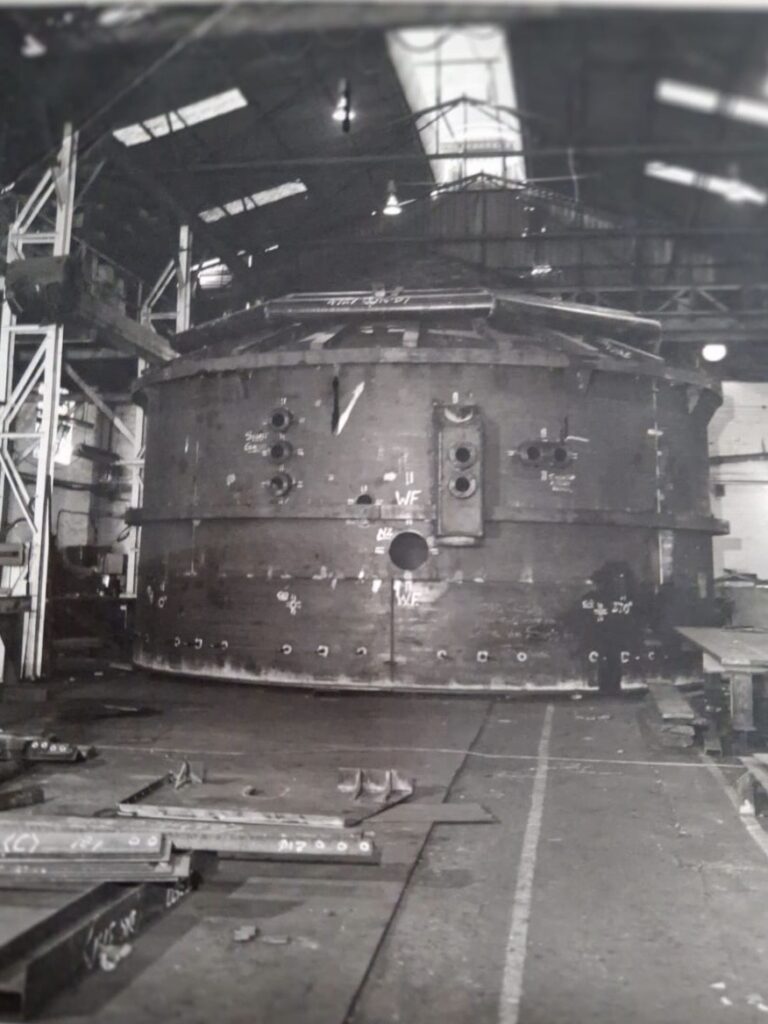
This is the first Continuous Vacuum Pan, built in South Africa for the Grande Boa Sugar Mill on Reunion Island.
I was responsible for the fabrication in South Africa and the installation at the Mill on the island -one of my finest moments. I was allocated three and a half weeks for installation.
My daughter was born two weeks before I went over to the island. I couldn’t wait to get back home ASAP. With my team’s assistance, the installation was completed in twelve days.
I returned home to abundant rewards for work well done, but the reward that meant the most was holding my beautiful daughter for the first time.
Our workstation consisted of three people: Paul Turnbull (the master tradesman), Samuel Nguni (his faithful assistant of over twenty years), and me—Samuel, son of John, the apprentice. While Paul had a lighter side, he was usually intense and laser-focused. One afternoon, the two “Samuels” were laughing, joking, and slacking off. Out of nowhere, a four-pound hammer came whizzing over our heads at lightning speed. We ducked just in time and immediately got back to business.
On another occasion, after a harsh reprimand, I decided I had had enough. I walked to the foreman’s office and requested a transfer. Even though it meant a practical demotion to operating a single machine, I accepted the transfer as a machinist. My departure was short-lived. Moments later, Paul marched over, grabbed me firmly by my overalls, and lifted me. “You’re not getting away that easily,” he said sternly in his booming voice. As I said, he was a giant of a man. He carried me all the way back across the shop floor to our station, set me on my feet, and gave me a firm talking-to.
Everyone watching that walk down the workshop floor had a good laugh, and I felt humiliated at the time. But I never looked back on it as a walk of shame; it was a match made in heaven. From that day forward, we never had another disagreement, and our bond as father and son was forever sealed.
The Master’s Legacy
Thanks to Paul Turnbull, I qualified as a top-class boilermaker. In a sense, I earned a “Master’s Degree” in engineering without ever setting foot on a university campus. How was that possible? Because I served and learned directly under a true master of the craft.
During my apprenticeship, I met a wonderful woman who became my wife in early 1975. We were honored to have Paul and his wife attend both our church ceremony and reception. A few years later, heartbreaking news reached the workshop: Paul had passed away suddenly at 5:00 AM on the very Monday he was due to return from annual leave. When my coworkers saw me break down in tears, they knew it wasn’t just a colleague mourning; it was a son grieving his father.
Looking back on this story, I see the unmistakable hand of God guiding me along a path He had uniquely mapped out:
- The initial inspiration: Directing my career choices on that high school preference form.
- The divine doorway: Prompting the Works Manager to grant me the 13th spot when all positions were filled.
- The unexpected mentor: Softening Paul Turnbull’s heart to choose and train me—the only apprentice he ever accepted.
I thank God for His guidance, and I salute my dear wife, who worked tirelessly to keep our household running while I pursued my studies. Most of all, I salute Paul—my earthly master—for his training, tough love, and unwavering encouragement.
After Paul’s passing, I chose to honor his memory by continuing my education. In my third year of training, Paul had often told me, “You are more than a boilermaker. Keep studying and become an engineer.” Guided by his words, I earned my Engineering Diploma and fulfilled that dream.
Above all, to God be ALL GLORY for HIS divine providence. As written in Jeremiah 29:11:
“For I know the plans I have for you,” declares the LORD, “plans to prosper you and not to harm you, plans to give you hope and a future.”
Liked what you read? click below & Share!