Cleopatra’s Heart
Chapter 5: Expedition to Taposiris Magna
By Samuel
👇 Click to translate:
Sandrine and her team establish camp at Taposiris Magna, setting up excavation grids and uncovering a mysterious subterranean drainage anomaly after a rare desert storm.
Sandrine felt a profound sense of accomplishment as they left Cairo behind. Back at her hotel room, she placed two vital phone calls. The first was to her home in London, where she eagerly reached her mother and grandfather.
“My dearly beloved family,” she beamed into the receiver, “Stage Six has officially concluded, and we are entering the primary phase—Stage Seven, where the real work begins. Tomorrow we transfer by train to Alexandria, and from there our complete team, equipment, and supplies will travel straight to the site. If all goes to plan, we’ll be pitching base camp by tomorrow evening.”
Both expressed their pride, reassuring her of their unwavering support.
Her second call was to her father. When the field tent orderly informed her that he was currently unavailable, she left a message. A short time later, her phone rang sharply.
“Good day, Cricket,” Philemon’s tired voice crackled over the line. “What was so urgent that I had to be pulled away from the trenches again?”
“Dad, I wanted to share some good news, but if you’re in a foul mood, I can call back later once you’ve calmed down,” she teased gently, a soft giggle escaping her lips.
He sighed, a faint chuckle breaking through his fatigue. “Alright, spill it, dear. What has you so excited?”
She updated him on her seamless logistics and their impending arrival at the excavation site by tomorrow evening. “How are things progressing on your end?” she asked.
Philemon’s tone sobered instantly. “Honestly, Cricket, we’re spinning our wheels. I’m starting to suspect the baseline intelligence the Smithsonian provided us is fundamentally flawed. We’re reviewing all our data, and tomorrow we plan to deploy our ultraviolet scanners to re-examine the strata—hoping for any breakthrough. Morale in the Valley of the Kings is dangerously low.”
After exchanging a few more family updates, they said their goodbyes.
The train journey north to Alexandria was smooth and uneventful. To break the monotony of the ride, the group enjoyed a light brunch in the dining car. Seth smiled, glancing around the table. “Good food has a magical way of lifting spirits. Come on, everyone—stop looking so dour. A smile won’t break your faces.” His good-natured prompt worked, drawing general smiles and easing the lingering travel fatigue.
Arriving in Alexandria, Mohammed Bashir’s logistical machinery operated with clockwork precision. Within an hour of arrival, they were traveling south across the desert terrain toward Taposiris Magna—the ancient coastal temple site dedicated to Osiris and Isis. Historically, Cleopatra was known as a devoted follower of Isis, making the location a prime geographical candidate for hidden antiquities.
As the sun dipped below the western horizon, painting the desert in amber and violet, the team pitched camp on an elevated ridge. For security, Mohammed had provided three four-man teams of elite, heavily armed private guards. Their tactical presence instantly deterred any unauthorized onlookers; they were hardened professionals who looked—and were—the real deal.
To boost camp morale, two field assistants proved to be exceptional cooks, earning universal praise over a hearty dinner. Afterward, Sandrine held a brief evening briefing before sending everyone to their tents to rest up for the grueling work ahead.
The camp stirred to life at 5:00 AM the next morning as the camp chefs brewed steaming pots of thick, dark coffee over open gas burners. By the time Sandrine stepped out of her tent, several guards and team members were gathered around crackling fire pits to ward off the severe morning desert chill.
She poured a mug of black coffee, stirred in three sugars, and joined the two Egyptian archaeologists—Ali Osman and Samir Khan—alongside their local guide, who was preparing to return to the city. They were deep in discussion regarding the initial clearing of surface vegetation and debris before mapping out the site’s master grid.
“I completely agree,” Sandrine said, joining them. “Let’s gather the entire team after breakfast to assign operational groupings.”
Breakfast ran from 6:00 AM to 7:00 AM daily. Afterward, the full expedition assembled before the equipment marquees. Sandrine stepped forward, her voice carrying clear, decisive authority.
“By virtue of funding and directing this expedition, I will act as Camp Director,” she announced. “Our two resident chefs will manage base camp logistics. The four senior archaeologists will spearhead distinct divisions:
- Ali Osman: Your team will establish baseline elevations and topographical leveling. Are you comfortable with that? (Ali nodded in agreement.)
- Seth Millar: You were always busy taking photographs back at university; you and your team will manage photographic documentation of every phase and grid sector.
- Jason Maple: As our most senior field director, you will oversee the master grid layout. We will all assist you with staking, measuring, and stringing the formation lines.
- Samir Khan: Your primary duty will be precise coordinate mapping.
Before we begin our technical assignments, however, we are all clearing the surface debris. Grab your tools, everyone. Let’s get to work.”
Except for the rotating security detail, the team moved out across the designated zone. By midday, the heavy brush was cleared, and the geometric lines of the master grid began taking shape. Following a well-earned lunch, work resumed with intense focus. Everyone knew that initial excavation phases were painstakingly slow, requiring immense patience with no immediate expectation of treasure.
True to form, the first two weeks flew by in a blur of dust and meticulous trowel work. By week three, however, a quiet wave of discouragement began to settle over the camp as finds remained elusive.
Then, unexpectedly, the desert skies opened. A torrential downpour lashed the site for three solid hours—a rare meteorological anomaly for the region at that time of year.
The following morning, the wisdom of pitching camp on high ground became immediately apparent. Looking down on the excavation zone, the grid stakes remained intact, though the earth was carved with sudden rivulets and pools of standing water. Seth was already out with his camera, documenting the geological impact of the storm from various angles.
By mid-morning, the fierce desert heat had begun evaporating the standing water, while the rest drained rapidly into the porous sand. As the five archaeologists walked the site together to assess conditions, Samir stopped abruptly.
“Look at this spot,” Samir remarked, pointing downward. “The earth here is completely dry—it’s entirely out of sync with the moisture levels across the rest of the site.”
They crowded around, inspecting the patch with growing curiosity. Seth raised his camera to capture framing shots of the anomaly and its surroundings.
Jason rubbed his chin thoughtfully. “I’m intrigued. I have a hypothesis, but before I voice it, I want to test it.”
“We’re a team, Jason—do share,” Sandrine urged with an encouraging smile. “No suspense necessary when we can think and work collectively.”
“Let’s haul buckets of water and flood this specific patch,” Jason suggested. “Let’s see why it drains faster than the surrounding soil.”
“That sounds like an excellent plan,” Samir agreed instantly.
Without waiting for further instruction, Samir and Ali rounded up six assistants and eight heavy-duty buckets, filling them to the brim and marching straight to the anomalous patch under discussion. A crowd of curious onlookers quickly gathered around as the water was poured over the dry earth.
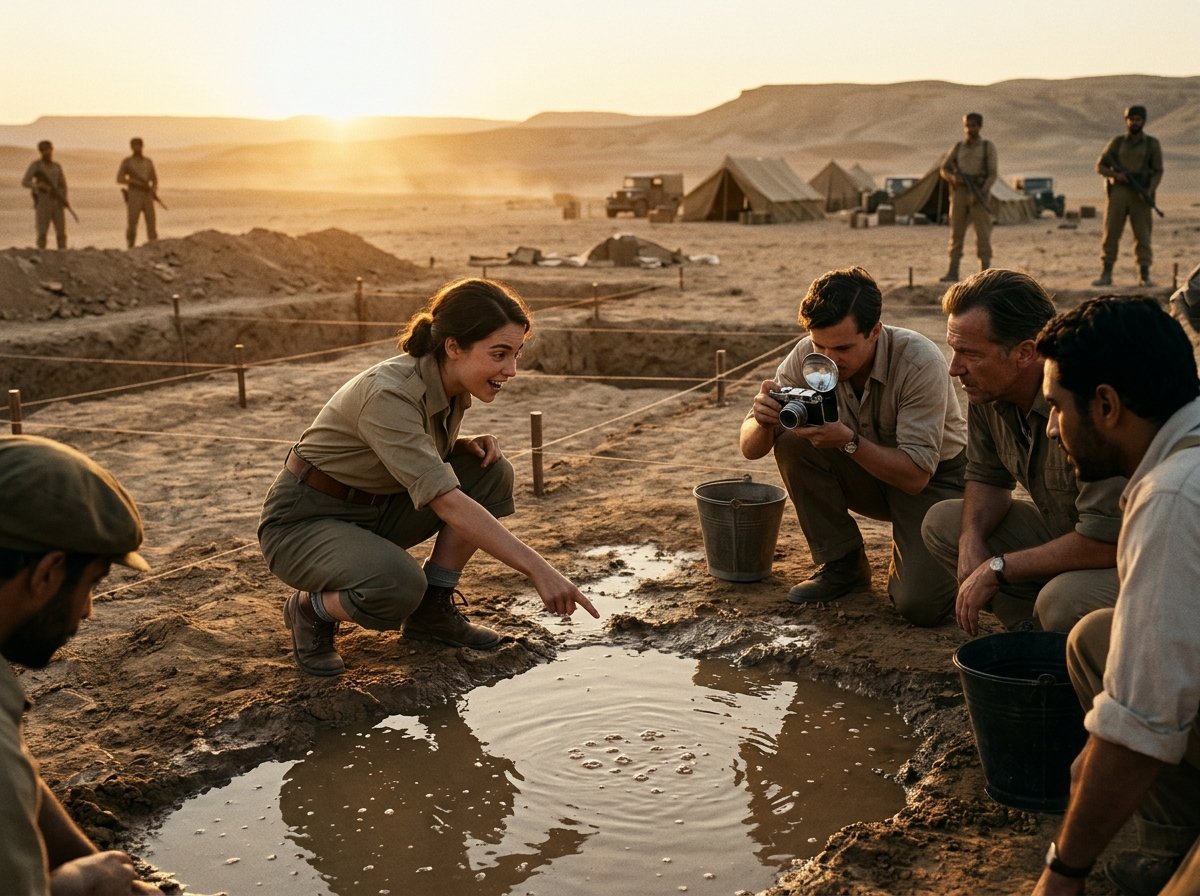
With over a dozen pairs of eyes fixed on the muddy ground, Sandrine’s heightened instincts kicked in. Moments later, she gasped, pointing downward with an excited cry.
“Look there! Tiny air bubbles!”
Rising steadily through the muddy water were faint, rhythmic bubbles. One had to look closely to catch it, but the evidence was undeniable: the water was seeping away into a hidden subterranean crevice entirely invisible to the naked eye.
Seth immediately adjusted his camera lens, attempting to capture a clear photograph of the micro-bubbles against the receding water. Excitement rippled through the team. With the sun dipping low on the horizon, they marked the coordinates and secured the area, eager to begin excavating the mystery the following morning.
Help this story travel. Click below & Share!