White Star: Rebel Queen of the Apache Hills
Part 1: The Refugee
By Samuel
Explore Part 1 of this post-Civil War Western fiction series. Fleeing ruin in the Reconstruction South, Al-Jay seeks refuge in Arizona’s Sierra Blanca mountains.
👇 Click to translate:
Part One
The American Civil War had finally drawn to a close, leaving the vanquished Southern states to face the grueling reality of Reconstruction. While the strategy was meant to restore health and wealth to a fractured nation, the reality on the ground was devastation. The cotton plantations—once the lifeblood of the Southern economy—lay denuded and overgrown. There was simply no manpower left to plant, tend, or harvest the crops. Countless able-bodied men had perished fighting for the Confederacy, and the formerly enslaved population was rightfully relishing its newfound freedom.
Discouraged by the herculean task of starting over from nothing, many farmers cut their losses, uprooted their families, and headed west to build a new life. Those who chose to stay faced a grim future of backbreaking labor and a desperate search for financial backing. Desperate, many leveraged their ancestral farms as collateral. When the high bank fees and impossible terms inevitably caused those loans to lapse, foreclosures stripped the families of their land titles. There was no leniency to be found. Instead, a quiet collusion brewed between corrupt banks and northern investment millionaires, all eager to acquire vast tracts of land cheaply and convert them into lucrative cattle ranches. To the winners, it was just shrewd business; to the losers, it was legalized theft.
This melting pot of greed and upheaval claimed its latest victim in Lady Jane Cavendish—known as “Al-Jay” to those closest to her. Because of the predatory banks, she lost her inheritance: High Ridge Acres, one of the loveliest estates in the valley, where two rivers meandered through lush, green fields.
Al-Jay was entirely alone. Her father and both of her brothers had lost their lives in the war, and her mother had succumbed to a fatal illness just as the fighting began. Desperate to save the estate, she had trusted her uncle, Harrold Cavendish, to help her secure a bank loan. It was a mistake she realized far too late. Harrold, valuing gold over flesh and blood, was secretly working with the local land-grab committee, headed by an avaricious land baron named Theodore “Teddy” Manasseh.
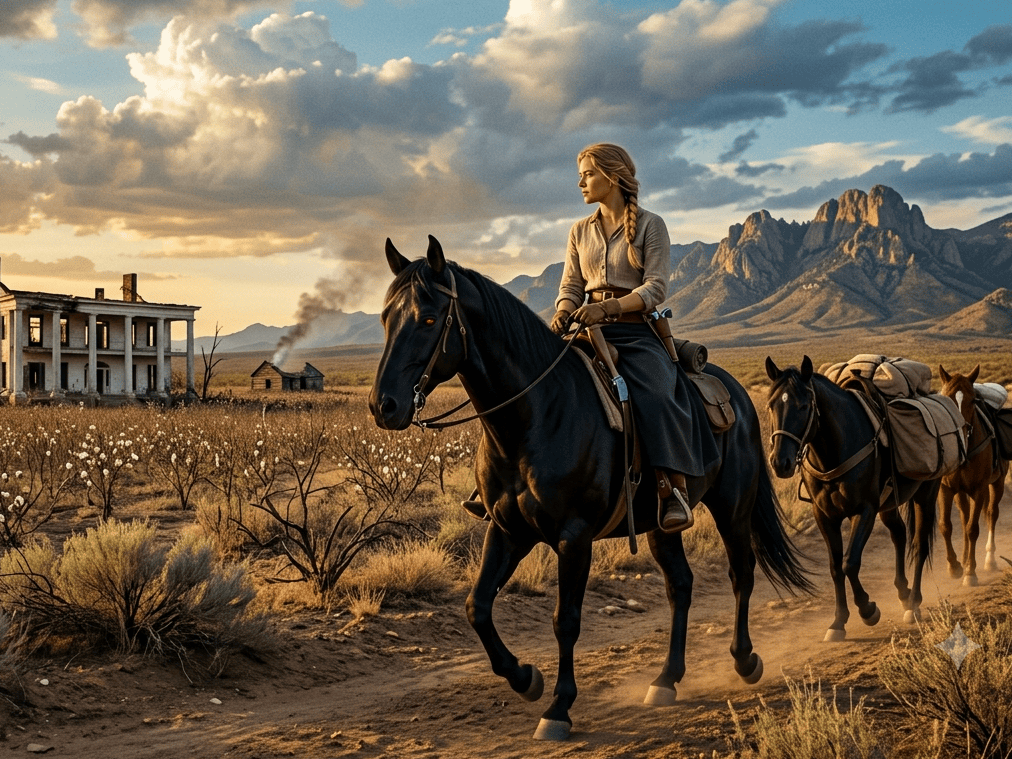
Left with nothing, Al-Jay refused to break. She cleared out her few remaining belongings, packing them into panniers loaded onto two sturdy packhorses. Finally, she mounted her favorite horse: a magnificent black stallion named Coalfire. The name fit him perfectly; his coat was a shiny, pitch-black satin, and his eyes burned with the intensity of glowing red embers. He was a temperamental, volatile animal, but between Al-Jay and the stallion existed a bond of pure devotion. She was a master equestrian, and when they moved together, rider and horse became one majestic, unstoppable force.
With no home left in the white man’s world, Al-Jay turned Coalfire’s head toward the rugged frontier. She was going to seek refuge among her second family: the Chiricahua Apaches, whose main camp lay hidden deep within the Sierra Blanca mountains of the Arizona Territory.
Their deep connection had begun years earlier, back when the first rumors of the Civil War were just starting to circle the South. Dahteste, the fierce daughter of Apache Chief Wild Bull, had traveled into the local town to trade for corn and a blanket. While there, she was accosted by three white youths who began tugging at her buckskin dress and hurling cruel insults. When Dahteste fiercely defended herself, one of the cowards drew a knife and slashed her upper left arm. It was a shocking betrayal of the uneasy peace she had previously experienced on her trading trips.
Al-Jay’s brothers, Matt and Joel, happened to be passing by and immediately intervened. With a few solid, well-placed punches, the brothers left two of the attackers flat on their backs, while the third fled down the street in a mighty hurry. They brought the bleeding Apache girl back to High Ridge Acres, where Al-Jay tenderly cleaned and bandaged the wound.
To ensure her safe passage home, Al-Jay insisted on riding back to the mountains with Dahteste. For protection, Al-Jay carried a Winchester lever-action rifle spiked into a leather boot on her saddle for easy reach, alongside a Smith & Wesson revolver holstered at her hip.
They arrived at the Apache camp just as the sun was dipping below the horizon, bathing the rugged peaks in crimson. Riding through the encampment, Al-Jay could feel dozens of hostile eyes boring into her back. Her heart hammered, but her expression remained a mask of calm; she knew that to show fear was to invite disaster.
Dahteste led Al-Jay straight to the Chief’s large tepee. Dismounting, the Apache girl signaled for Al-Jay to wait outside while she stepped within. Moments later, Chief Wild Bull exited alongside his daughter. Looking at the young white woman, he spoke in remarkably clear English.
“Please, dismount from your horse,” the Chief said, gesturing warmly. “Come into my home.”
A wave of astonished whispers rippled through the gathered tribe members. Inside the tepee, Dahteste related the entire story of the assault and the profound kindness of the Cavendish siblings.
When she finished, Chief Wild Bull looked at Al-Jay with deep gravity. “Thank you for your family’s kindness. We do not often receive it from your race. Seeing how late the hour is, please stay with us for the night. Tomorrow, I will send a detail of my finest warriors to escort you safely home.”
Grateful and exhausted, Al-Jay accepted. They shared a hearty meal, and a comfortable sleeping spot was arranged for her in Dahteste’s tent. Though sleeping on the hard-packed earth was foreign at first, her weariness soon took over, and she fell into a deep, peaceful sleep.
The following morning, the Chief called a council of the elders to explain the white woman’s presence. Upon hearing of the Cavendish family’s honor, the elders looked at Al-Jay with newfound respect. When the Chief called for volunteers to escort her back to her valley, nearly every able-bodied brave stepped forward.
The Chief selected six of his top warriors. But just as they prepared to mount up, Al-Jay unhooked her Winchester rifle. Bowing respectfully before Chief Wild Bull, she held the weapon out in both hands.
“Chief, please accept this rifle as a gift from my family to yours,” Al-Jay said, a wry smile touching her lips. “I have just one request: promise you will never use it against me or my kin.”
The warriors broke out into hearty laughter, cheering at the young woman’s bold wit. Al-Jay embraced Dahteste, mounted Coalfire, and rode out of the camp, knowing she had forged an alliance that time could never erase.
Now, years later, fleeing the ruin of her old life, Al-Jay returned to the only sanctuary she had left. After a grueling journey across the territories, she approached the familiar foothills of the Sierra Blancas. An Apache lookout spotted her from a high ridge and, recognizing the woman on the pitch-black stallion, gave the signal. A welcoming detail of warriors quickly rode out to escort her into the heart of the camp.
The reunion was bittersweet. Dahteste rushed forward to greet her old friend, her eyes instantly falling upon the heavily laden packhorses.
“Al-Jay,” Dahteste said softly, sensing the heavy sorrow hanging over her. “What has happened?”
“Dahteste, can we go inside?” Al-Jay asked, her voice tight with emotion. “I will tell you everything.”
They gathered inside the Chief’s tepee, where Wild Bull welcomed her with a solemn nod. For the next half hour, the room was silent save for Al-Jay’s voice as she recounted the betrayal by her uncle, the loss of her family, and the theft of High Ridge Acres.
When she finished, Chief Wild Bull spoke with fierce certainty. “Al-Jay, you are blood to us. You are one of us now. You will stay for as long as you need.”
Tears pricked Al-Jay’s eyes as she bowed her head. “Thank you, Chief. Thank you, Dahteste. You are the only true family I have left in this world.”
To give her space of her own, the tribe quickly cleared a beautiful plot of land close to Dahteste’s lodge and erected a personal tepee for Al-Jay. That evening, after a welcoming feast, the two young women stayed up late into the night, laughing and crying as they caught up on everything they had missed during the long, dark years of the war.
The next morning, the camp awoke to a hive of intense activity. Stepping out of her tepee, Al-Jay nearly collided with Dahteste, who was already striding toward her lodge.
“Please, tell me what is happening,” Al-Jay asked, looking around at the rushing braves. “Why is everyone clearing out?”
“Our scouts bring word of a massive buffalo herd heading into the valley,” Dahteste explained, her eyes bright with excitement. “Our winter stores are dangerously low. The hunting party is preparing to ride out, and I am going with them. Will you join us? It will be an experience you won’t forget.”
Al-Jay didn’t need to be asked twice. A spark of her old spirit flared to life. “I haven’t been on a hunt since I rode out with my brothers before the great war. I accept the invitation.”
They joined the hunting party, which consisted of twenty men—ranging from eager teenagers out to prove their manhood to seasoned, scarred warriors—alongside six other women. Dahteste explained that the women rode along to handle the crucial, exhausting work of skinning the beasts and preparing the meat.
As they rode, Al-Jay noticed a curious detail. “Dahteste, why are so few of the men carrying rifles? Almost all of them have bows and arrows.”
“A great warrior gains his reputation by riding directly into the center of a thundering herd,” Dahteste explained with pride. “He chooses his target, matches its terrifying speed, and brings it down with a single, perfectly placed arrow. His courage, strength, and agility are all judged by that one act of marksmanship. It sounds simple, but doing it from the back of a galloping horse takes a lifetime to master. Do not worry—we will take part in the hunt, but we will use our rifles.”
Al-Jay let out a breath of relief. “That makes me feel a bit better. Though you must promise to teach me how to wield a bow when we return.”
Before departing, the hunting party gathered before Chief Wild Bull and a weathered, elderly woman with sharp, knowing eyes.
“Who is she?” Al-Jay whispered.
“She is our medicine woman,” Dahteste murmured reverently. “She and my father will bless the hunters before we ride. They are asking the Great Spirit in the sky for protection and a bountiful harvest. It may seem strange to you, but it is the bedrock of our culture.”
Following the solemn fifteen-minute ceremony, the valley erupted with fierce war cries and the joyous cheers of the tribe as the hunting party galloped out of camp.
They soon rendezvoused with the trackers who had gone out before dawn. The party reined in their horses, listening intently as the trackers pointed toward a wide, rolling plateau.
“They say it is a massive herd,” Dahteste translated, a fierce smile on her face. “The hunt will be good today.”
The sun was approaching its zenith when they finally crested a ridge and saw the buffalo grazing peacefully in a lush, golden valley. It was a staggering sight, thousands of massive beasts stretching across the horizon, causing Al-Jay to stare in absolute awe. But there was no time for contemplation. With an explosion of shouts, the young braves raced down the ridge, eager for glory.
The sudden charge sent the herd into a panicked frenzy. Within seconds, the earth began to violently shake, a deafening roar echoing through the valley as thousands of heavy hooves beat against the dirt. Darting dangerously in and out of the dust cloud, the Apache hunters worked with terrifying efficiency.
Al-Jay rode hard alongside Dahteste, completely transfixed by the sheer spectacle. She didn’t fire a single shot from her Winchester, entirely engrossed in the raw power and ancient tradition playing out before her eyes.
Once the elders saw they had taken enough meat to feed the tribe through the harsh months ahead, they called a halt to the hunt. The remaining herd thundered over the horizon, disappearing into a cloud of dust.
Riding back through the field, Al-Jay watched as the Apache women immediately got to work. Every piece of the animal was honored: skins were carefully harvested for clothing and lodges, bones were preserved to craft vital tools, and the rich meat was packed onto horses.
That night, the camp erupted in a massive celebration of dancing and singing. The tribe was profoundly grateful for the bounty, and even more grateful that no hunters had been injured.
During the feast, Al-Jay was introduced to a sacred tradition. To the Apaches, eating the heart, liver, and kidneys of a fresh kill was a delicacy meant to transfer the beast’s strength to the consumer. To honor her presence, the elders presented Al-Jay with a raw slice of the buffalo’s liver.
She hesitated, looking at the bloody offering. But with the gentle coaxing and laughing encouragement of her new friends, she took a bite. It was a strange, shocking taste, but she swallowed it down, officially joining in the spirit of the tribe.
Over the weeks that followed, Al-Jay dedicated herself to mastering the Apache bow. A mock shooting range was set up on the edge of camp, and several of the older, veteran warriors took turns training her.
It was a bruising, exhausting discipline. Merely pulling back the heavy, stiff bow cord tore at her muscles, but learning to hold that tension, aim steadily, and release with precision while keeping her balance took weeks of grueling failure. Yet, Al-Jay possessed an iron will. With dogged determination, her arrows began to find the center of the target.
One evening, while sitting around the roaring council fire, one of the young braves looked at her curiously. “Al-Jay, you own a fine rifle, and your aim with a pistol is true. Why do you spend your days bleeding your fingers on a bow string?”
Al-Jay looked into the flames, her eyes reflecting the dancing firelight. “As you all know, my uncle used deceit and legal trickery to steal my family’s land. I intend to make him pay. I do not wish to murder him—I want to ruin him. I want to take the things he holds dearest. On his ranch, he keeps a prized European breeding bull that is worth a small fortune. I am going to steal into his land and kill it.”
She looked around at the listening warriors. “If I go onto his land with firearms, the cracks of gunfire will alert his guards and his crew. But if I use a bow and arrow, I can strike silently. I will exact my price, and they will never even know I was there until the morning sun rises.”
Chief Wild Bull let out a booming, appreciative laugh, his eyes shining with respect. “Never underestimate a woman’s desire for righteous vengeance! Al-Jay, from this night forward, the tribe shall call you White Star, the Warrior Princess. You shine brightly in our darkest night, and you possess the unyielding heart of a true warrior.”
The name stuck instantly, and Al-Jay wore her new title with profound pride.
Liked what you read? click below & Share!