Destiny awaits in Chapter 3 as Charlotte joins the ultra-classified special forces unit known as Team DAZE ahead of a perilous tactical night jump.
👇 Click to translate:
Chapter Three
For the first three months of specialized training, the classroom became as demanding as the field. The recruits endured daily lectures on American military history, tracing the lineage of the armed forces from their inception. The curriculum was designed to instill an unyielding pride in serving their country, emulating past heroes, and embracing the profound reality of placing one’s life on the line if the nation required it.
The instructors hammered home a foundational philosophy: “Make fear your companion, not your enemy. Senseless bravado gets people killed. Keep your fear on a short leash, because dialed-in fear sharpens your senses and helps you accomplish the mission.”
Once the theoretical foundation was laid, the regimen shifted to an intense six-month block of hand-to-hand combat. They trained extensively in karate, judo, boxing, and tactical knife and sword fighting. Weight training built raw power, while sprint intervals maximized explosive speed. Every day concluded with a grueling hour in the indoor pool. They were pushed to master long-distance speed swimming and silent underwater traversal, skills that later evolved into combat scuba diving and advanced sub-surface operations.
Just as the trainees thought they had reached their absolute physical limits, the pipeline transitioned to air combat and airborne infiltration. They were informed that this all-encompassing, cross-branch training was the forge for a new tier of special forces. They were being groomed as an elite task force capable of acting as an agile extension of the US Navy SEALs for direct-action raids.
After three exhausting years, the pipeline culminated in elite airborne training. Charlotte proved to be a natural paratrooper, particularly excelling in two high-stakes disciplines: night HALO (High Altitude Low Opening) jumps and precision-canopy landings, where putting boots on a dime was the difference between success and catastrophic failure.
To mark the completion of the cycle, a commissioning ceremony was held at the air force base. It was a strictly low-key, classified affair with a limit of two guests per graduate. For Charlotte, the restriction posed no issue; Major Timothy Raven and Aunt Ethel were the only family she wanted there to pin on her new epaulettes.
Of the initial forty candidates handpicked for the program, only twenty-four stood on the parade deck. The high attrition rate was a testament to the brutal standard of the selection process—and the caliber of those who endured.
They were designated Team Delta-Alpha-Zeta-Epsilon—codenamed Team DAZE.
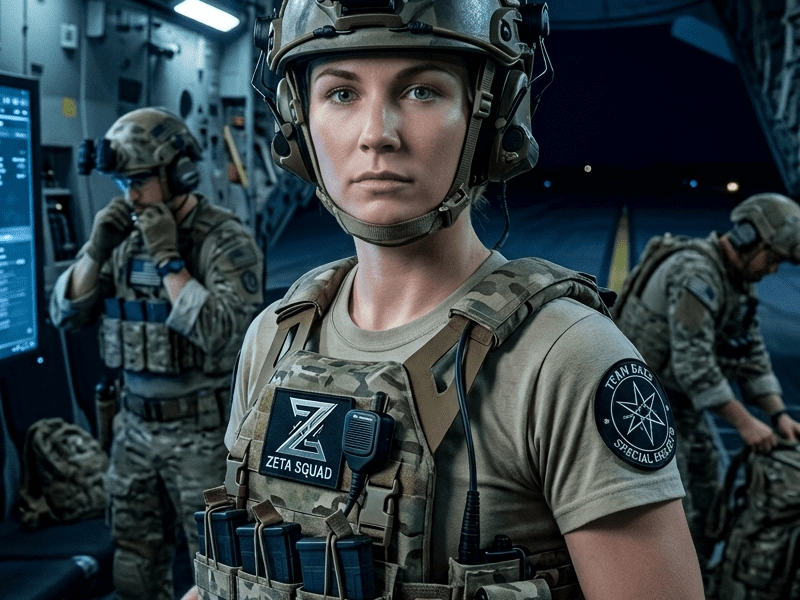
The twenty-four operators were divided into four tactical elements of six: Delta, Alpha, Zeta, and Epsilon squads. Because of her exceptional tactical marks and natural authority, Charlotte was appointed Team Leader of Zeta Squad. At her request, and his own, Samuel Israel was assigned to her unit. She immediately designated him her wingman.
Their operational headquarters was an entirely off-the-grid facility buried deep in the familiar wastes of the Mojave Desert, designated Camp Omega. The compound was outfitted with cutting-edge technology and its own dedicated motor pool, which included ten advanced tactical land vehicles, four transport helicopters, and three supersonic jet transports to ensure rapid deployment anywhere in the world. Every single one of the twenty-four operators had been cross-trained to hold advanced certifications as high-speed drivers, helicopter pilots, and jet aviators. This self-sufficiency stripped away the need for an expansive footprint, leaving Camp Omega staffed only by a skeleton ground crew, maintenance techs, kitchen staff, and their commanding officer, Lieutenant General Andrew Hastings.
The true test of Zeta Squad’s training arrived barely a month after graduation.
An alarm triggered a high-priority Homeland Security alert in nearby San Diego. A crew of heavily armed bank robbers had botched their escape and taken over a prominent downtown branch, holding a crowd of civilians hostage. Because of the squad’s proximity, local authorities requested immediate special forces intervention.
Back at Camp Omega, the team leaders drew straws to determine who would take the ticket. Charlotte pulled the short straw. Within five minutes, Zeta Squad was airborne.
When they arrived on-scene, the intersection was a textbook tactical mess. The local police had parked four squad cars directly in front of the bank’s main exit, entirely exposed. Local FBI field agents had just arrived, a news helicopter was hovering dangerously low overhead to broadcast live footage, and a massive crowd of civilian onlookers was already gathering behind thin police tape.
Charlotte led her squad past the perimeter to link up with FBI Special Agent John Boss, who had assumed initial command of the crisis. As they approached, the bank’s internal comms link patched through to the command post.
The gang leader’s voice echoed over the radio, tense and demanding: “Me and my boys have thirty-three hostages in here. We are locked, loaded, and dangerous. We won’t hesitate to paint the walls if our parameters aren’t met. First, I want all local cops and FBI suits moved back across the street. You do that right now, and I’ll give you three old-timers as a down payment.”
Agent Boss signaled his teams to comply, and within minutes, three elderly hostages rolled out of the heavy glass doors.
While the perimeter shifted, Charlotte’s team spread out the building’s architectural blueprints across the hood of an FBI SUV. Samuel leaned over the schematic, his eyes tracking the ventilation lines.
“Look right here,” Samuel said, tapping a finger on a shared bulkhead. “The bank shares an industrial air-conditioning loop with the adjoining warehouse for easier maintenance access. But to seal the property line, the engineers installed a high-velocity barrier inside the duct: three heavy-duty stainless-steel fans running in series, just four meters apart. They spin at a thousand RPM.”
“So a forced entry from the warehouse side is a death trap,” Charlotte observed, examining the blueprint. “The blades would shred anyone who tried to crawl through. But knowing you, Samuel, you didn’t point that out just to tell me it’s impossible. What’s the bypass?”
“The local kill switches are independent, but the master relay is inside the bank’s maintenance closet, right outside the main vault,” Samuel explained. “If we can get a message to an insider—someone on the bank staff—to throw those breakers for exactly five minutes, three of us can breach the duct, bypass the dead fans, and establish a foothold inside the building before the security team even looks up.”
Gabe, one of Zeta’s heavy weapons specialists, looked at him with raised eyebrows. “Since when do you read industrial HVAC blueprints like a master contractor, Sam?”
“My dad’s an architect,” Samuel replied with a quick grin. “I used to look over his shoulder and ask too many questions when I was a kid. He taught me how to read structural layers.”
Charlotte turned to Agent Boss. “Agent Boss, can we get an encrypted line or a message to someone inside the staff?”
“We can leverage their lunch order,” Boss replied quickly. “The leader just demanded eight large pizzas, ten bottles of soda for the hostages, and a dozen burritos for his crew. The delivery just arrived at the outer checkpoint. I can tape a low-profile instruction note to the inside base of a pizza box. We’ll direct the bank manager to create a distraction—say, demanding a bathroom escort for a couple of employees—while he slips away to kill the fan breakers.”
“Do it,” Charlotte ordered. “We move the second those fans stop spinning.”
Half an hour later, Boss gave Charlotte the nod. Zeta Squad positioned themselves inside the darkened warehouse. The low, heavy hum of the industrial ventilation system suddenly died, leaving only the sound of settling metal.
“Fans are down. Go, go, go,” Charlotte whispered into her comms.
Samuel, Gabe, and Clint cut through the access hatch and slid through the tight metallic corridor, navigating past the idle, razor-sharp steel blades. Within ninety seconds, they had slipped into the bank’s rear corridor. Samuel moved to a vantage point behind a decorative partition overlooking the main lobby, keying his throat mic.
“Zeta Leader, this is Zeta Two. We are in position,” Samuel reported quietly. “Visual confirmation on five hostiles. They’re heavily armed. Two have semi-automatic carbines near the main entrance; the other three are holding the crowd with large-caliber handguns. The perimeter looks stable. They think they own the room. Requesting permission to neutralize.”
Charlotte’s voice came back instantly through his earpiece: “You are cleared for tactical neutralization, Zeta Two. Watch your backstops. Minimize civilian casualties. Protect the asset.”
“Copy that,” Samuel said. He turned to the two operators beside him. “Listen up. I’ve got the two carbines by the front doors. Gabe, you take the two guards anchoring the far side of the lobby. Clint, the leader, is yours—the one leaning against the teller counter. We shoot to disarm, but if they switch to lethal posture, you drop them. Our priority is the thirty hostages. We initiate on three, giving them zero reaction time. One… two… three.”
The three operators stepped out from the blind spot simultaneously, their suppressed weapons tracking to their targets with mechanical precision.
Three suppressed shots cracked through the lobby in under three seconds. Clint’s and Gabe’s targets dropped their weapons instantly, clutching shattered shoulders and wrists as they slammed into the tiled floor. However, Samuel’s second target—one of the door guards with a carbine—reflexively began to raise his barrel toward the crowd of hostages. Samuel adjusted his point of aim instantly and fired a second time, a clean headshot that dropped the gunman instantly.
“Room’s secure! FBI, move in!” Samuel shouted, covering the remaining suspects as Clint ran to unlock the heavy front doors.
Before the panicked hostages even began to file out into the sunlight, Zeta Squad had already subdued the surviving criminals, zip-tied them, and marched them out the back exit into local police custody. The entire deployment had taken less than two hours. Long before the local news crews could bypass the outer police barricades to find out who had conducted the raid, Zeta Squad was packed, airborne, and heading back into the deep safety of the Mojave.
Liked what you read? click below & Share!