The Rebirth of a Shattered Life
Chapter 3: The Architecture of the Heart
By Samuel
The journey East begins. Watch as Thomas leaves his past behind to step into an entirely new world.
👇 Click to translate:
Chapter Three
Thomas and his tour group arrived in Agra just after lunch. Exhausted from the journey, they were treated to a light meal of finger foods before settling into their allocated rooms. The afternoon off was a welcome reprieve; the late-day heat was nearly unbearable. They all agreed that while America had its scorching days, they were nothing compared to the intensity of an Indian summer.
Thomas, ever the architect, discovered that the Taj Mahal was within walking distance of their hotel. Rather than wasting the afternoon in a fitful nap, he decided to view the legendary monument to love. He didn’t know it then, but this decision would be the most pivotal one he had made in more than six months.
Dressed in light off-white cotton pants and a white long-sleeved linen shirt, he purchased an umbrella in the hotel lobby to shield himself from the sun. Following the concierge’s directions, he began his stroll toward the mausoleum.
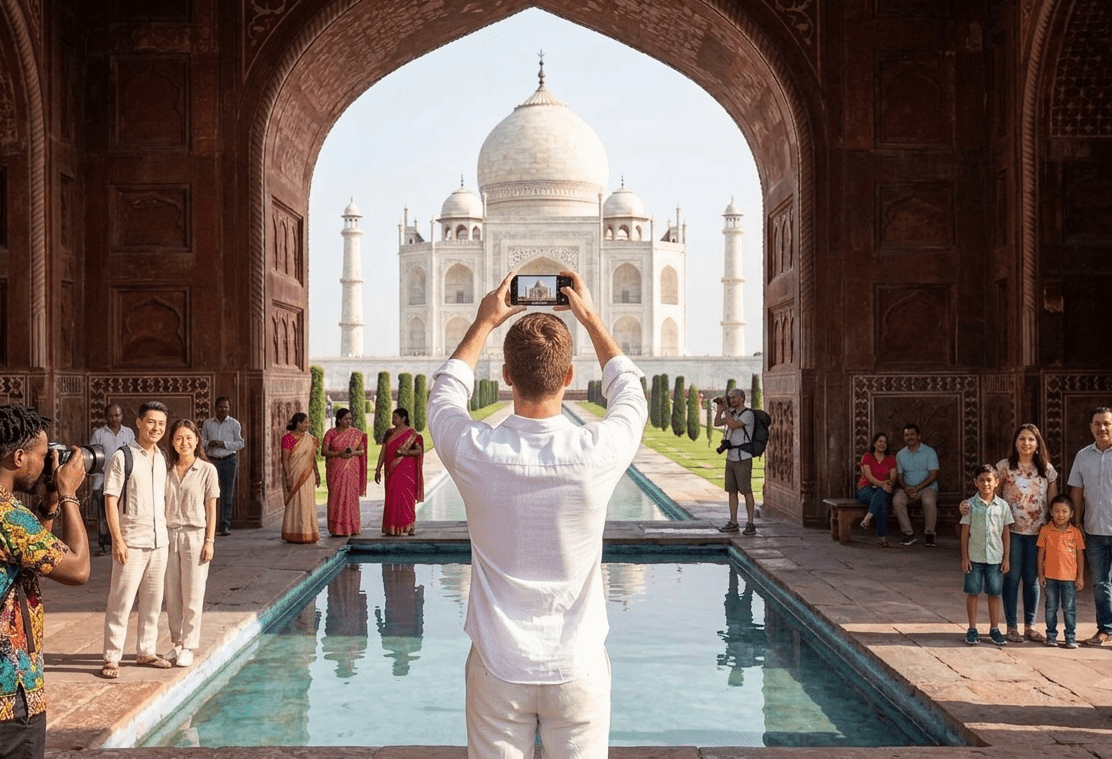
He saw the grand structure from a distance, but as he drew closer, he was struck with awe. Its pure white façade shimmered brilliantly in the afternoon sunlight. Stepping through the Great Gate, he was amazed at how the archway perfectly framed the mausoleum. He pulled out his phone—the latest model, purchased specifically for the trip—and began taking snapshots of the central long pool, the symmetrical walkways, and the cypress trees that stood like silent sentinels on either side.
Standing among a throng of jovial visitors, Thomas felt a sudden, sharp pang of grief. Stopping at the entrance, he whispered to himself, “Shah Jahan, you found your true love in Mumtaz Mahal and honoured her with this. Sadly, my love story is but a shattered dream.”
“Are you alright?” a soft voice asked.
Thomas started. A young Indian woman had touched his arm, having overheard his lamentation. He wanted to tell her, in the polite way of a stranger, that it was none of her concern, but when he looked at her, he saw a gaze filled with deep, genuine empathy.
“Young lady,” he said, his voice thick, “it’s a long story. Talking about it causes me untold pain.”
“In India,” she replied gently, “we have a saying: a burden shared is a burden made lighter. I don’t mean to be forward, but I am a trained psychologist. Your cry touched my soul. Please, let me help.”
Thomas hesitated. “It’s difficult to revisit that chapter. My heart is still an open wound.”
“I am Didier Patel,” she said, offering a small smile. “I don’t want any visitor to our land to be overcome with grief. We are a joyful nation, and I want you to feel that too. Let’s find a quiet corner out of the sun. I have the whole afternoon to listen, and I would feel blessed to hear your story.”
A part of Thomas’s mind urged him to excuse himself and retreat to the hotel, but another part recognized the sincerity in her eyes. This was the turning point in his long, sorry existence.
“Didier,” he said, “I’m Thomas. I’m not sure why I trust you, but… let’s talk.”
They found a quiet spot at the far end of the grounds. There, Thomas opened his soul to this enchanting girl. He told her of Sophia, their childhood bond, their vows of purity, and the crushing betrayal by his own cousin. He spoke of the months of self-exile and the loss of his career.
“So here I stand,” he concluded, “a man stripped of his dignity. What do I do next?”
Didier remained silent for a long moment, absorbing his words. “Thomas, I feel your pain, but betrayal is as old as mankind. You are not alone. Don’t you feel a little lighter now, just for having spoken it?”
As they walked back to his hotel, she learned he was part of a larger tour group. “For the next two days,” she suggested, “excuse yourself from the group. Let me be your personal guide. I will show you the hidden beauty of Agra—the Taj, the UNESCO sites, and the parts of our city most tourists never see.”
The idea pleased him immensely. They agreed to meet in the lobby at eight the next morning.
The following morning, Thomas explained his detour to his surprised tour mates before meeting Didier in the foyer. Outside, he apologized for his abruptness, explaining he wanted to avoid the inevitable cross-examination from his fellow travellers. She nodded understandingly, and they set off.
They spent the day immersed in beauty. They passed through the East Gate of the Taj Mahal and entered the inner shrine. Thomas was enthralled by the intricately carved marble lattice screens and the cenotaphs inlaid with precious stones. They took dozens of photographs—some of the exhibits, some of Didier, and a few shy selfies together.
By the end of the day, Thomas was overjoyed. He began to look at Didier with new eyes. She was a modern-day Aphrodite: a sharp, elegant nose, deep eyes, and long, sleek black hair. He caught himself staring at her more than once, and to his surprise, she didn’t seem to mind at all.
For dinner, she took him to a restaurant in the old city for aromatic curry, dosa, and lentils. They were comfortable, the tension of their first meeting replaced by an easy, growing affection.
The next day, they met outside the hotel to avoid further stares. Didier wore a salmon-coloured pantsuit with a white silk shirt, a striking contrast to Thomas’s white pants and cream blazer. They toured the Agra Fort, exploring the palaces and mosques housed within its massive walls. Later, they visited Fatehpur Sikri, which Thomas found to be an architectural masterpiece.
Didier was a font of knowledge, sharing histories, anecdotes, and cultural nuances. That afternoon, over tea and samosas at a sidewalk café, Thomas reached out and covered her hand with his.
“Didier,” he said, his heart racing, “I have two things to ask. First, I am falling in love with you. Second, I want you to be my guide for the rest of my trip. I will pay for all your services, your travel, and your meals. What do you say?”
Didier took a moment to gather her thoughts. “Thomas, I have started to develop feelings for you as well. But there is a catch. I am a born-again, practicing Christian. My faith forbids me from entering a relationship with someone of a different belief. I don’t know where you stand.”
Thomas was taken aback. “I thought you were Hindu. How did you…?”
“It’s a long story,” she smiled. “I am a fourth-generation Christian. It began with my great-great-grandfather, Vikram.”
She told him the story of how Vikram had been diagnosed with pediatric leprosy as a child. In desperation, his parents had turned to the legendary missionary, Sadhu Sundar Singh.
“Sundar Singh told them of his own conversion,” Didier explained. “He was a Hindu priest searching for truth. One night, he told God that if he didn’t receive an answer by morning, he would throw himself under the four o’clock train. At the last moment, a light filled his room, and he heard the voice of Jesus. Vikram was healed three days later, and my family has never looked back.”
Listening to her, Thomas realized how shallow his own faith had been. His Christianity was a matter of habit—attending church on holidays or the occasional Sunday morning. Didier’s faith was a living, breathing thing: Bible studies, prayer meetings, and an unwavering love for her Saviour.
That night, lying in his hotel room, Thomas knew he wanted more than just Didier’s hand. He wanted the peace she possessed. He knelt by his bed and dedicated his life to Jesus. Immediately, he felt a weight lift—the burden of his past sins and his grief dissipating. He fell into the most restful sleep he had known in years.
When he told Didier the next morning, she beamed. Quoting scripture, she said, “So He gives His beloved sleep.” She pulled him close and kissed him. “I can officially accept your offer to be your girlfriend now. And by the way, you are named after the patron saint of India—Thomas the Apostle, who first brought the gospel to our shores.”
The rest of the trip was a whirlwind “Odyssey” across India. They visited Kolkata, Hyderabad, Jaipur—the “Pink City”—and the financial hub of Mumbai. Between their travels, they stopped back in Agra so Thomas could meet her family.
The Patel home was a modest, festive double-storey house. The dining table was laid with white bone china and silver cutlery, a sign of the family’s high standing in the community.
“Mum, Dad, everyone,” Didier announced, “this is Thomas Jones.”
Thomas met Arjun and Nithya, Didier’s parents; her sister, Lakshmi; her brother, Rohan; and her grandmother, whom everyone called “Mummy.” The conversation flowed freely, moving from Thomas’s career as an architect to what life was like in America.
Finally, Arjun asked the question Thomas had been anticipating. “Young man, now that you’ve found this ‘new self,’ what are your plans?”
Thomas took a deep breath. “Arjun, Nithya… I ask for your permission to court your daughter. I intend to marry her, if she will have me.”
Silence fell over the room. Her parents looked at each other, then at Didier’s radiant face. They nodded in unison.
“Yes, Thomas,” Arjun said. “But our Christian principles are non-negotiable. Do you accept?”
“I would have it no other way,” Thomas vowed. “I would like to have a private engagement ceremony here tomorrow. I need to return home shortly to settle things with my parents, but I will return in a month to marry Didier in her church and take her back to America as my wife.”
Grandmother “Mummy” chuckled. “It sounds like you two have planned this all along! You have my blessing, Thomas. But if you don’t look after her, I will come to America and teach you the error of your ways!”
As the family crowded around Didier to congratulate her, Arjun gripped Thomas’s hand. “Take good care of my daughter, Thomas. Make her as precious to you as she has always been to me.”
Liked what you read? click below & Share!