Svetlana, The Wolf Girl of Siberia
Chapter 1: The Cold Cradle of Sevvostlag
By Samuel
Discover Svetlana Ivanova’s gripping Siberian Gulag escape in Chapter 1. Survival, family tragedy, and wild wolves collide in a brutal Soviet prison camp.
👇 Click to translate:
Chapter One
Svetlana Ivanova was the young daughter of Sergey and Elena Ivanov. During her early childhood, the Soviet populace endured unimaginable hardships under the iron fist of Joseph Stalin—a ruler so ruthless that Winston Churchill famously likened his regime to a plague. Most citizens lived in constant terror of Stalin’s state security apparatus, the NKVD. Detractors of the regime were disposed of quickly by firing squads or sent to face a slow, grueling end in the vast, ice-bound penal system known as the Gulag.
There was no place on Earth more feared than the camps of Siberia.
Sergey Ivanov was an outspoken and fearless man. Though small in stature, he possessed a solid, barrel-chested build that commanded respect. His quiet but clear distaste for the communist regime had already marked him for elimination, but his popularity among the local working class had kept the secret police at bay.
That fragile safety was shattered the day Sergey stepped in to defend an elderly man.
Three NKVD guards, heavily intoxicated, had stumbled out of a local tavern just as the elderly man accidentally brushed past them. Angered, the guards shoved the old man to the pavement, hurling insults and kicking him as he lay bleeding and defenseless. Unable to stand by, Sergey lunged forward. With perfectly timed, powerful punches, he quickly sent the thugs stumbling backward.
But Sergey’s luck ran out. At that exact moment, an NKVD Commandant turned the corner with four armed soldiers.
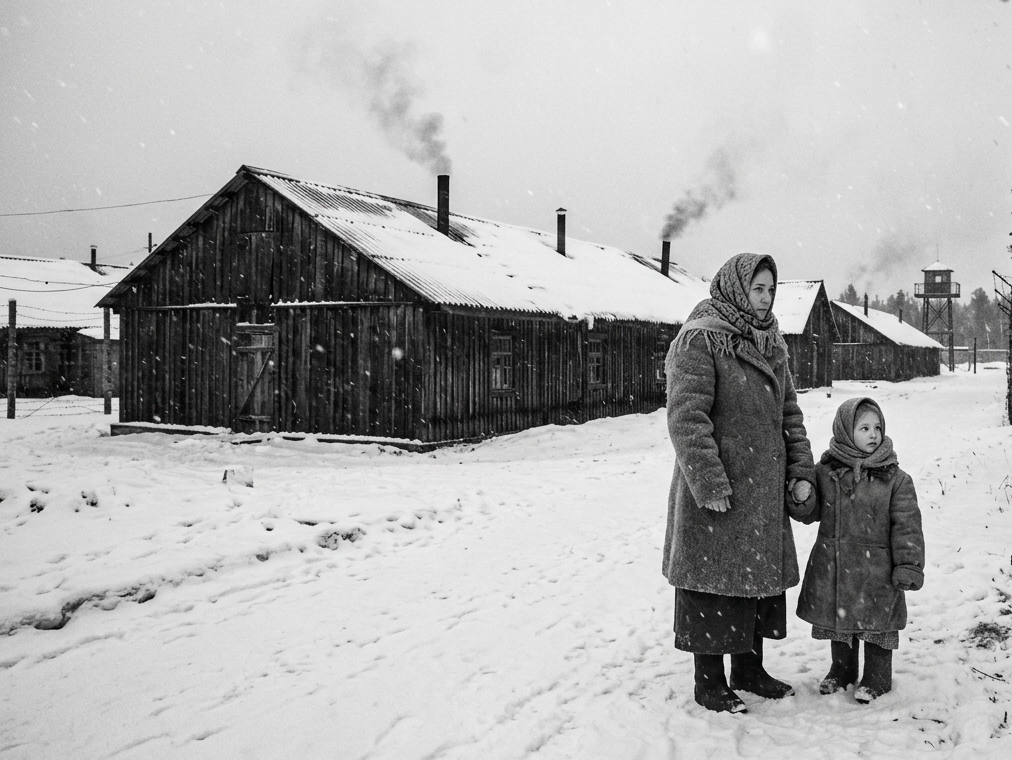
Sergey was instantly subdued and dragged into custody. After a mockery of a trial, he was sentenced to life at the notorious Sevvostlag camp in northeastern Siberia. To make an example of him, the state rounded up his family as well: his wife, Elena; his seven-year-old son, Oleg; and Svetlana, who was barely three. Since no one else was available to care for the children, they were shipped north alongside their parents. No neighbors dared to speak out against this cruelty, paralyzed by the fear of sharing the same fate.
Nestled beside a freezing coal mine and a rich gold deposit, Sevvostlag was a living graveyard. The inmates—separated into male and female barracks—were worked to the bone to extract gold and fuel for the Soviet machine. Children under six were permitted to stay with their mothers in the drafty, overcrowded barracks.
Rations were meager and rancid. The bread was consistently green with mold, and the watery turnip soup was often thick with weevils. Meat was a luxury seen only once a week, if at all. For the women, the worst of the nightmare lay in the brutal, unchecked abuse of the camp guards.
Due to the extreme cold and starvation, inmates died daily. A dedicated “burial squad” worked tirelessly to dump bodies into unmarked mass graves. Because the train cars arrived regularly with fresh prisoners, the camp commanders never worried about a labor shortage. Sevvostlag was not a place to live; it was a factory of death.
Barely a month after their arrival, young Oleg contracted black lung disease from the coal dust. Without medicine or warmth, his frail body gave out.
Svetlana was heartbroken. For days, she wept uncontrollably, refusing to eat. Eventually, exhausted and starving, she crawled out of her shell of grief. Elena held her tightly, whispering softly into her hair.
“Dry your eyes, my love,” Elena murmured, her voice trembling but warm. “Be glad for him. His suffering is over now. He is in heaven, and you will see him again one day.”
Too young to understand the dark nature of the abuse her mother endured in the barracks, Svetlana learned to adapt. When the guards raided the quarters, she would huddle in the corner, pressing her eyes shut and blocking her ears to drown out the screams. This exposure to the worst of humanity did not break her; instead, it forged an unbreakable steel in the toddler’s spirit.
During these dark years, Svetlana had only two sources of light: her mother’s fierce protection and the quiet compassion of a guard named Grigory, whom everyone called Grego.
Elena was an educated, well-read woman with a deep love for literature. Whenever they had a quiet moment in the corner of the barracks, she used her knowledge to teach her daughter. Svetlana was like a sponge, eagerly soaking up every lesson. She fell in love with the stories of the ancient Greeks—their rich mythology, the rigid discipline of Sparta, and the democracy of Athens.
Elena taught Svetlana to read and write by scratching letters in the dirt with a pointed stick. The other camp children mocked Svetlana, calling her efforts a waste of time.
But Svetlana merely stared back at them with cold, determined eyes. “When I escape,” she whispered to herself, “I will use this.”
Elena drummed one crucial directive into her daughter’s mind: “Svetlana, if you make it out of this place, you must remember the men who did this to us. They are evil to the core. You must seek justice—not just for our family, but for everyone they destroyed. Remember their faces. Remember their names.”
“I will, Mama,” Svetlana promised.
“Commandant Dmitry Vladimirov, the man who arrested us and sent us here,” Elena said, her voice dropping to a harsh whisper. “And the butcher of this camp, Commandant Konstantin Gromov. Etch them into your mind.”
With her mother’s plea for vengeance burning in her chest, Svetlana’s resolve to escape solidified.
By the time Svetlana turned four, summer had arrived, transforming the harsh Siberian landscape into a temporary paradise of lush greenery. A rushing river fed by mountain snowmelt flowed through the valley. Bordering the far side of the river, opposite the camp, was a dense, towering forest of ancient pines.
With a child’s curious innocence, Svetlana discovered a small, rusted opening in the barbed-wire fence at the back of the women’s compound. She realized she could slide her small body through the gap to play in the pristine fields near the river, escaping the bleakness of the barracks.
On her fourth trip outside, Grego spotted her. Rather than sounding the alarm, the guard watched the tiny, determined girl with quiet admiration. Feeling pity for the innocent child, he refused to report her. Instead, when his fellow guards weren’t looking, he dragged a discarded sheet of corrugated iron over the hole. It hid the gap from the searchlights while still allowing Svetlana to slip behind it for her secret excursions.
Because the camp gates and heavy patrols were concentrated on the other three sides of the perimeter, this back fence remained largely unmonitored. One afternoon, Svetlana crossed paths with Grego near the woodpile.
“Why is there no one guarding the back fence?” she asked in a whisper.
Grego looked around nervously before kneeling to her level. “There used to be guards out there, little one,” he whispered. “But a pack of wolves caught them off guard in the brush. By the time we heard the screams, it was too late. The Commandant figures the wolves are a better deterrent than any fence. Please, be careful out there.”
Svetlana looked at the guard with a seriousness that defied her age. “My name is Svetlana. Thank you, Grego.”
“Keep your head down, Svetlana,” he replied with a sad smile.
To protect her secret sanctuary, Svetlana never told her mother where she went. When Elena asked where she had been playing, Svetlana replied, “Just playing in the dirt with the other children, Mama.”
Occasionally, Svetlana would find small strips of dried, cured meat tucked behind the iron sheet next to the fence. She knew instantly they were from Grego.
As her confidence grew, Svetlana’s inquisitive mind pushed her further into the wilderness. She found a shallow point in the rushing stream and waded across, entering the deep shadow of the pine forest.
In a sunny clearing, she stumbled upon two wolf cubs tumbling and playing in the grass. Svetlana approached them slowly, showing no fear. Hearing her soft footsteps, the cubs stopped and sniffed the air, their curiosity piqued by the strange human child. Svetlana reached into her pocket, pulled out two strips of Grego’s dried meat, and extended her hands.
The cubs cautiously approached, snatched the flavorous treats, and happily began to chew.
A low, vibrating growl sounded from the thicket. Svetlana turned slowly to find herself staring into the amber eyes of a massive, snarling she-wolf. It was her first face-to-face encounter with a fully grown apex predator.
The she-wolf bared her teeth, assessing the threat to her young. But as she looked at the calm, steady gaze of the child, the wolf sensed no fear and no hostility. The mother wolf stepped forward, placing her large body between Svetlana and the cubs in a silent display of ownership, but the growling stopped. Satisfied that her cubs were safe, the she-wolf turned and nudged her offspring back toward their den.
Svetlana exhaled slowly. Deciding that was enough adventure for one day, she slipped back across the river and returned to the compound.
A few weeks later, Svetlana found a new gift left by the iron sheet. Alongside a generous portion of dried meat lay a sheathed, six-inch steel hunting knife. She gripped the hilt, testing its balance. It was heavy, sharp, and perfect.
Thank you, Grego, she thought, slipping the weapon into her boot.
Svetlana knew that when she escaped, she would need resources. She began to formulate a plan to smuggle gold nuggets out of the mine. First, she needed a secure hiding place that was easily accessible but completely hidden from the guards. Using the knife, she dug a ten-inch-deep hole in the hard earth near her secret fence exit. She lined it with dry leaves, placed her small treasures inside, and carefully packed the dirt back down, covering the spot with a patch of living grass.
When Svetlana turned six, the camp administration deemed her old enough for the labor details. She was assigned to the same gold-mining team as her mother.
On her very first day, Svetlana experienced the humiliating security checks. When exiting the dark shafts, every prisoner—man, woman, and child—was forced to strip entirely naked in front of the guards to ensure no gold was being smuggled out. It was a degrading process designed to break the human spirit, leaving psychological scars that time could never heal.
A week into her mining duties, a sharp, jagged rock sliced deeply into Svetlana’s left forearm. The wound bled heavily, and the camp medic washed the gash and wrapped it tightly in a thick linen bandage.
Looking at the bulky white wrap, Svetlana saw an opportunity.
That evening, huddled in the corner of the barracks, she whispered her plan to her mother. Elena gasped, her eyes wide with worry.
“If you manage to smuggle the gold out, Svetlana, what will you do with it? What use is it to a child?”
Svetlana looked at her mother, her voice flat and filled with an icy determination. “I am not going to die in this place, Mama. When the time is right, I will escape. I will use the gold to buy my passage out of Siberia, and then I will hunt down every man who put us here. I will make them pay for Oleg.”
Elena stared at her daughter, seeing the fierce, calculated fire of Sergey in her young eyes. “How can I help you, my brave girl?”
“Tomorrow in the mine, when the guards are distracted, I want you to pretend to trip and cry out in pain,” Svetlana whispered. “While they are looking at you, I will slip two gold nuggets into the folds of my bandage, right against the cut. They won’t search under a fresh wound.”
“But the pain, Svetlana… the raw gold against an open cut will be agonizing.”
Svetlana’s face did not waver. “A small price to pay for our freedom.”
The plan worked flawlessly. Despite the burning pain of the raw metal pressing into her open flesh, Svetlana did not make a sound during the strip search. That night, safely in the dark of the barracks, she unrolled the bandage and pulled out two unpolished gold nuggets. To her, this wasn’t theft; it was back pay for the lives the Soviet state had stolen from them.
Over the next three days, Svetlana repeated the dangerous stunt, securing a total of ten high-grade gold nuggets. Knowing that pushing her luck would eventually lead to discovery, she halted the smuggling and buried her wealth in her secret cache.
Svetlana’s mind was constantly working, analyzing every detail of the camp’s routine. One rainy evening, a heavily intoxicated guard staggered past her barracks. As he stumbled over a mud puddle, his service pistol—a semi-automatic Tokarev—slipped quietly from his leather holster into the mud.
Svetlana didn’t hesitate. She darted forward, scooped up the heavy steel firearm, and hid it beneath her oversized coat.
Later that night, she slipped through the fence and buried the pistol alongside her gold and hunting knife. She reasoned that the guard would never report the loss of his weapon; losing a firearm under Stalin’s regime meant a one-way ticket to the firing squad. He would undoubtedly lie and find a replacement black-market pistol through his connections to save his own skin.
As the months passed, Svetlana grew taller and stronger. Squeezing through the rusted gap in the fence was becoming an increasingly difficult task. She had carefully bent the wire to widen the opening, but she knew that if she made it any larger, the guards on the watchtowers would notice. Her window of escape was closing.
During her rare visits to the forest, she hoarded small essentials, including pieces of flint for starting fires. On one of her final excursions into the woods, she was suddenly confronted by an unfamiliar gray wolf. The beast was massive, its eyes locked onto Svetlana as its ears flattened in a hostile snarl. It tensed its hind legs, preparing to spring.
Before the intruder could launch itself, a massive shape burst from the brush. It was Svetlana’s she-wolf friend.
The mother wolf stood fiercely in front of Svetlana, her throat vibrating with a terrifying roar. A second later, her two cubs—now almost fully grown, powerful predators in their own right—stepped up on either side of their mother. The three of them formed an impenetrable wall.
The intruding wolf evaluated the odds, took a step back, and vanished into the dense pines of the Siberian taiga.
Svetlana let out a breath she hadn’t realized she was holding. She stepped forward and wrapped her arms around the thick fur of the she-wolf’s neck, whispering her gratitude. She did the same to the two younger wolves, feeding them the last of her dried meat. They were no longer just wild beasts to her; they were her pack.
The fateful day of her escape arrived at the onset of the brutal Siberian winter.
A massive, catastrophic dust explosion rocked the nearby coal mine. The ground trembled violently, and a towering column of black smoke and fire erupted into the gray sky. Dozens of guards and hundreds of prisoners were instantly trapped or killed in the collapse. Chaos erupted across the camp. Alarm sirens wailed, and guards scrambled in every direction to secure the perimeter and deal with the unfolding disaster.
Knowing the administration would be unable to account for the bodies or the headcount for hours, Svetlana knew this was her only chance.
She ran to her mother, throwing her arms around her neck for one last, desperate embrace. “I love you, Mama. I will come back for you. I swear it.”
Elena kissed her cheek, tears streaming down her pale face. “Run, Svetlana. Don’t look back.”
Svetlana darted through the smoke-filled yard, slipped silently through her secret hatch in the fence, and dug up her hidden cache. With her gold, her knife, and her stolen pistol secured, she sprinted toward the freezing river.
She waded through the icy water, the numbing current clutching at her legs, and scrambled up the opposite bank. Scurrying into the shadow of the pine forest, she headed straight for the wolves’ den.
But when she arrived at the rocky lair, only the two young wolves emerged to greet her. The mother wolf was nowhere to be found.
Liked what you read? click below & Share!