CLICK ABOVE TO LISTEN
Caesar’s Emissary
-Olac the Gladiator
By Samuel
👇 Click to translate:
Chapter Four
Before their departure, Olac found time to speak with Berenice, explaining he was leaving on a critical mission for Julius Caesar, expecting to return in about a year. Berenice looked at him, her gaze intense.
“You had better return,” she insisted, her voice trembling slightly. “It is not an option. I was waiting for a more opportune moment to share the news with you, but I cannot delay telling you. I am with child, Olac. You must return to both me and our child.”
Olac’s reaction was instantaneous: initial shock melted into overwhelming joy. He grabbed her, lifted her off her feet, and spun around the room, laughing wildly as she peppered his face with kisses. The ambition that drove him now had a precious, vulnerable new focus.
They stepped apart for a final farewell. When Olac joined Atticus and the others, he could not hide his exhilaration. One of the soldiers, noting his visible joy, asked, “Are you so soon tired of your wife’s companionship that you are happy to go away on this journey?”
Olac clapped the soldier on the shoulder. “To the contrary, my friend. I just learned from her that she is with child! You all had better make sure that this trip is successful and that we get back home as soon as possible.”
Atticus, ever the protector, was the first to embrace him. “Your safe return is assured by me, Olac. Berenice need not worry.”
They reached the coast swiftly and boarded their waiting vessel. The journey began with immediate discomfort. The first day at sea saw both Atticus and Demetrius—the centurion and the Thracian fighter—plus several soldiers afflicted by seasickness. Olac and a few others, having spent time at sea in the past, fared well. By the third day, however, the whole group had recovered, forced only to contend with the elements: stiff winds, heavy rain, and choppy seas that stalled their progress.
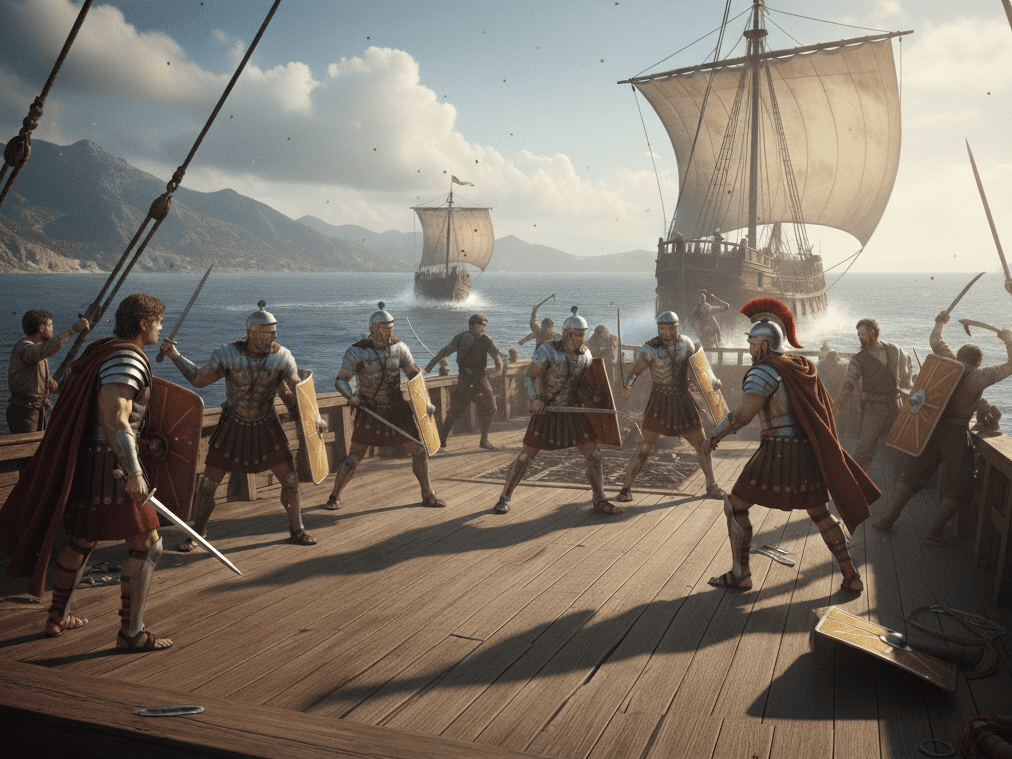
No sooner did the weather clear than danger arrived. While rounding the Iberian Peninsula, a pirate ship gave chase, eager for bounty. They had chosen the wrong target. The pirates were met by the ship’s hardened crew, reinforced by three leaders and nine Praetorian Guards operating with lethal efficiency. The engagement was swift and brutal. The pirates suffered a crushing blow, the few survivors setting sail in immediate, terrified flight.
Olac’s party faced no further trouble at sea and eventually disembarked on the familiar coast of Demetae. Atticus, with his customary wit, declared: “It’s good to be on terra firma. The firmer the ground, the less the terror.” Olac laughed, relieved to feel solid earth beneath his feet.
As they prepared to travel, Olac scrutinized the coastline. His clouded memory cleared; he recognized the area as close to his childhood home. Gratitude was offered to the gods they worshipped individually. Olac, overcome by purpose and sentiment, requested a detour to engage his kinsmen. His closely bonded friends readily agreed.
A day’s ride brought them into a village where they were met with cold, suspicious stares. Olac, ever honourable, scrutinized the growing crowd, hoping for a familiar face. He was soon rewarded: he spotted a tall young man.
“Cullum, dear friend, do you not recognize me?” Olac shouted, dismounting quickly. “I am Olac, son of Balder. How is my dear mother?”
Cullum stared, then his face erupted in disbelief. “Olac! Is it truly you? We received word that your father’s party was attacked and that you were all slain!”
The two men embraced fiercely. As they stepped apart, Cullum addressed the crowd: “This is Olac, who was groomed to become your King! Fate dealt otherwise. The only word we received was that all were killed, save one man who escaped. His younger brother, Erik, now rules over us.” He paused, his expression clouding. “Olac, your dear mother died of a broken heart not long after we received the news.”
Olac absorbed the grief with quiet dignity. He introduced his party to Cullum, and the villagers, their cruel stares replaced by expressions of welcome, embraced the returning Prince.
At the family home, Olac was led inside to meet his brother, Erik, the tribe leader. Erik, recognizing the stranger’s features, leaped from his seat. The two brothers clung to each other in a powerful, emotional reunion.
“Olac, I am overjoyed to see you,” Erik said, pulling back, “but this Roman outfit… I do not understand.”
Olac quickly introduced his travelling companions and explained they were on their way to Londinium (London) to deliver a message from Caesar to the garrison. Erik, though saddened by their imminent departure, hosted a large celebratory supper that night.
The next morning, after a hastily prepared breakfast, the visitors bid their emotional goodbyes. Olac, knowing the value of being duty-bound, embraced his brother, and they parted.
Their journey continued eastward toward Londinium to obtain fresh horses and victuals, and, crucially, to request a Centurion, Markus, and eighty soldiers to ensure safe passage north. The larger escort travelled towards Lindum (Lincoln) and then to Boracua (York), where they secured a guide for the final leg toward the Scottish border—the very point where Hadrian’s Wall would later stand.
As they were crossing the territory of the Brigantes, they were intercepted by a small, exhausted group sent by Mark Antony from Rome. The messengers were travel-worn, having ridden post haste to bring devastating news:
Rome was in turmoil. Mob rule had erupted following the assassination of Julius Caesar in the Senate. Sixty senators, led by Brutus and Cassius, had turned on him, each plunging a sword into Caesar. Mark Antony himself was busy trying to quell the uprising. The perpetrators tried to justify their heinous act as preserving the Republic from an Emperor, but their motives were clearly driven by personal ambition and resentment of Caesar’s popularity.
To Olac and his group, hearing of Caesar’s death brought the realization that their emissary journey had become a useless exercise. The core of their purpose had been extinguished.
The next day, the mission broke camp. The mood, previously one of hope and shared camaraderie, turned quiet and sombre. They immediately began the journey back to the coast, everyone deep in thought about their future and the political vacuum in Rome. After waiting a full week, they secured passage on a ship bound for home, four months after they had set out.
Liked what you read? click below & Share!