CLICK ABOVE TO LISTEN
Caesar’s Emissary
-Olac the Gladiator
By Samuel
👇 Click to translate:
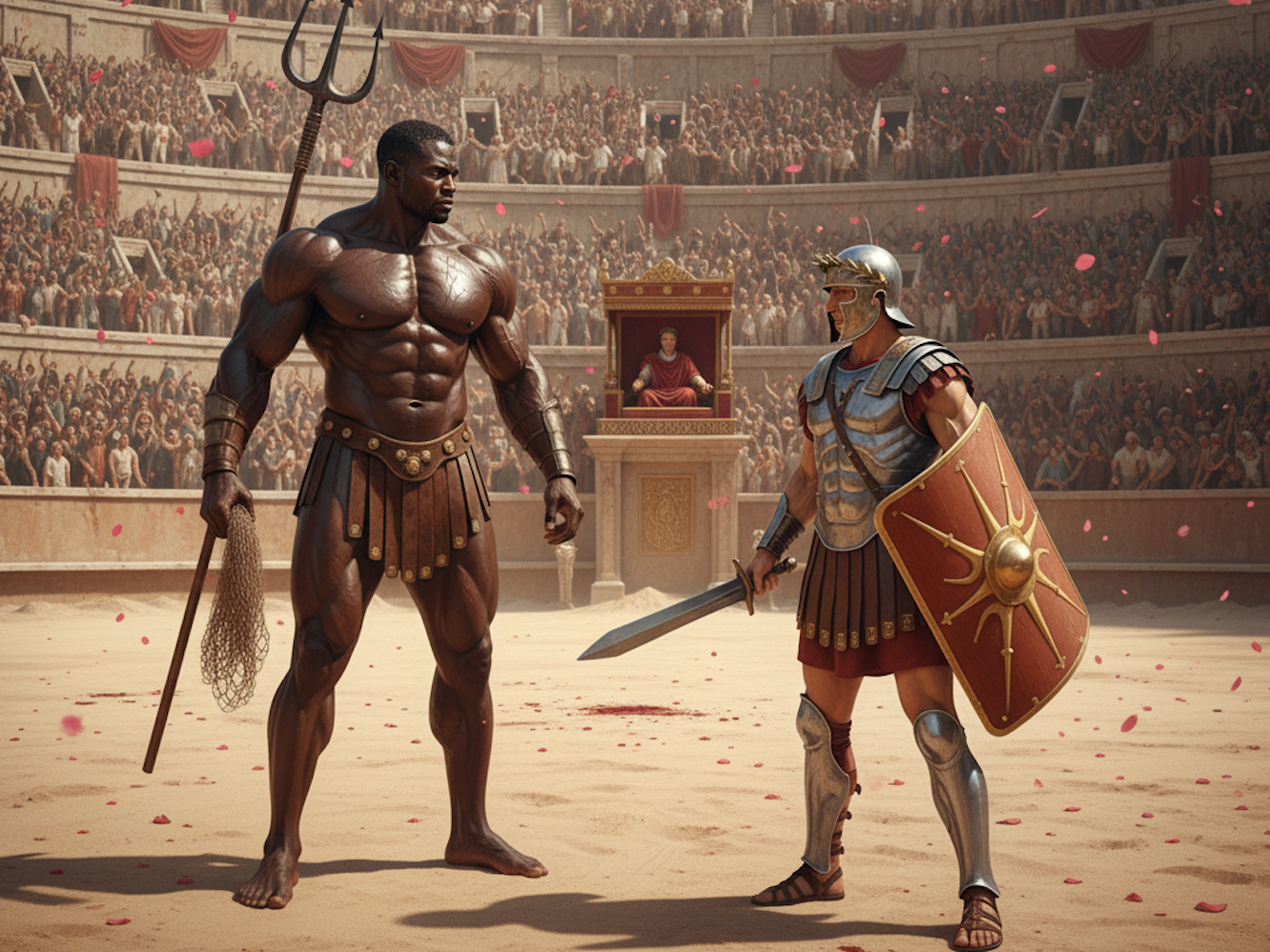
Olac first gained Julius Caesar’s attention the day he was pitted against the Roman crowd’s favourite, a giant Nubian called Belshazzar. Belshazzar, towering at 6’7” (just over two meters), was broad-shouldered with muscles that rippled under his dark, almost mahogany-coloured skin. This was to be his final fight, for the gladiator law rewarded any man who won ten battles in the arena with freedom and Roman citizenship. His opponent that fateful day was Olac, a gladiator of little note, having won only three duels in lesser-known arenas.
Chapter Two
On first assessment, most men saw Olac, at only 5’11”, as mere bait—a mistake Belshazzar was quick to make. With a wry grin, the giant stepped out towards Olac with dangerous overconfidence. Yet, had Belshazzar made a closer inspection, he would have seen a fully equipped fighting machine. Olac was muscular, his waist narrow, his arms huge for his height, and his long legs built for speed. Crucially, Olac had a sharp analytical mind; he never made assumptions, always planning on the side of caution.
Belshazzar, a Retiarius, was skilled with the trident and net. Olac preferred the fighting style of a Secutor, utilizing a short, wide-bladed sword, a fully armoured sword arm, a small, round shield, and a full helmet. Julius Caesar was seated in the royal canopy, commanding an excellent view.
As was customary, the two opponents approached Caesar. The crowd, delirious after six preceding fights, screamed “Belshazzar!” Hearing his name, the giant lifted his arms, soaking up the frenzy. Before looking up at Caesar’s box, he glanced at Olac, hoping to see fear, but was disappointed. Olac, seeing Caesar for the first time, waited patiently.
Caesar stood up and, with outstretched arms, silenced the multitude. Both gladiators, with a loud voice, declared in unison: “We who are about to die, salute Caesar.” Caesar looked at them, then signalled the commencement of the battle, a contest both knew was to be to the death.
They circled each other, searching for an advantage. Belshazzar, blinded by hubris, rushed at Olac, casting his net. He realized his mistake too late: Olac had anticipated this move (demonstrating his intelligence). Like a cat, Olac sprang away, moving with lightning speed to slash Belshazzar across the chest before the giant could block. With effortless ease, Olac was back at a safe distance, well out of the trident’s arc of attack. It dawned on Belshazzar that he had gravely underestimated his opponent. This would be a fight for his life.
The dance continued. The crowd, sensing the shift in momentum and the raw tension, fell silent, watching with bated breath. This time, Olac pressed the attack, rushing in to deflect the trident thrust with his shield. Belshazzar barely stepped back in time, avoiding a sword strike across his chest by a mere handbreadth.
The backward and forward rhythm continued until Belshazzar, sliding his net along the arena floor, expertly snagged Olac’s left foot, causing him to topple backward. Belshazzar saw his opening and rushed forward, intending to impale Olac through his upper torso with the trident. Too late, he realized his fatal error: Olac had purposefully allowed the move to play out, feigning disadvantage (his strategic ambition). At a speed that few eyes were able to follow, Olac deflected the trident and, in one motion, thrust his sword, arm extended, deep into Belshazzar’s chest. The heart thrust brought instant death.
As Belshazzar fell, Olac rose to his feet and walked toward Caesar. The crowd was silent, their former hero no more. Caesar, who prized the intellectual strategy of combat more than brute force, stood and saluted the winner. Strangely, he requested that Olac be cleaned, dressed in a Roman tunic, and brought to his villa for an interview later that day.
That night, when Olac arrived at Caesar’s villa, a feast was in progress. Caesar instructed Atticus, a highly trusted Praetorian Guard, to take Olac to the audience room and ensure he was given food and drink. Olac was seated at a large central table. One of Caesar’s young slave girls, Lydia, tended to him while Centurion Felix and two other soldiers stood guard at the door.
When he had finished eating, Olac rose to his feet. Atticus soon returned with Caesar, who entered the room and proceeded to the large, imposing chair at the center. Caesar indicated that Olac should sit.
“I am both impressed and intrigued by you,” Caesar stated, his tone measured and direct. “Tell me, whence do you hail, and by what fate were you made a gladiator? In short, historically, what is your past?”
Olac, starting at the beginning, spoke with quiet dignity and integrity. “I am the son of a chieftain, Balder, named after a Norse god. I am a Celtic Briton from an area called Demetae on the west coast of Britain. As a Prince, I was trained in every art of hand-to-hand combat known to our tribe: wrestling, sword fighting, and the javelin. My training focused on strength, endurance, and developing a supple body, all in preparation for future leadership.”
Olac recounted his history: a coastal trading trip with his father, an overwhelming attack by marauding pirates, and the ensuing battle where his father and most of their men were killed. “I and three comrades were overpowered and shackled. We were kept alive as oarsmen, with the eventual plan to sell us off.” He recounted two gruelling years slaving at the oars, maintaining the fierce determination to escape and avenge his father. By the time the pirates returned to their home port of Utica in North Africa, he was the sole survivor.
He was sold at a city auction to a gladiator school owner. At the Ludus in Carthage, his training continued, winning several fights. “A Roman Consul, Marcellus, having witnessed my prowess, offered a large sum for me, which was accepted. I only returned to the Roman arena when Consul Marcellus returned to Rome.”
Caesar, having listened intently and watched Olac’s behaviour, analyzed him. That very night, Julius Caesar sent for Marcellus and offered to buy Olac. Marcellus, however, refused to take payment, offering Olac to Caesar as a gift, which Caesar graciously accepted.
Julius Caesar took Olac back to the feast gathering, calling for silence upon their entry. Many of the guests, who had attended the afternoon’s fights, recognized Olac. They sized up the newcomer, wondering what extraordinary event was unfolding.
When silence was achieved, Caesar introduced him. “This is Olac the Gladiator, whom I have just received as a present from Marcellus, a man who runs one of the best gladiator schools here in Rome. As his new owner, I have decided, and now introduce him to you all, not as my slave, but as a free person who now shall have full rights as a Roman citizen!”
What started as a low murmur erupted into loud applause, with many nodding their approval. As was customary, men stepped forward to congratulate Julius on his acquisition and to extend the hand of acceptance to Olac. Olac’s integrity and controlled honour had immediately earned him the respect of the powerful.
Atticus, at Caesar’s request, escorted Olac to his newly allocated quarters within the section where the Praetorian Guards were housed. This arrangement was not lost on Olac. He was to be a member of Squadron One, one of four allocated to Caesar’s household. He later found out that the majority of the guards were veterans of the feared Ninth Legion. Olac realized this was not only a test of loyalty but also an unparalleled demonstration of trust.
Early the next morning, he witnessed the changing of the Praetorian Guard. His first impression was that they were an elite, well-drilled, and formidable group of soldiers. He did not have an audience with Julius that day, but was introduced to some of the guards. He had several training spells with them during the day. He recognized that the primary focus of his training would now shift: it would be to move him away from the isolated gladiator’s fighting methods and toward adopting the Praetorian soldier’s way of warfare—mastering formation drill and the collective strength of the legion. His ambition had not only delivered him freedom but also a purpose at the very heart of the Roman Empire.
Liked what you read? click below & Share!