Chapter 1: The Domestic Maelstrom
The Turning Point -The Tipping Point
By Samuel
Welcome to Chapter 1 of this gripping military thriller, where we uncover the origins of elite operator Charlotte Raven as she takes her first steps into a brutal new life.
👇 Click to translate:
Chapter One
The Turning Point is often synonymous with the Tipping Point. It is that precarious moment when an object, once balanced, is nudged over the edge—much like the “last straw” that finally breaks the camel’s back. It represents a definitive change in direction. In this story, it is the moment our heroine’s life shifts from the shadows of obscurity toward the light of recognition.
Charlotte and her younger brother, Charles, were the children of Richard and Sandra Raven. They were a quintessential middle-class family, living in a four-bedroom stone-brick house at the end of Kensington Close in San Diego, California. To the outside world, they were the picture of suburban stability; inside, however, every morning was a chaotic whirlwind of demands and delays.
Sandra Raven was the “Home Executive,” rising before dawn to manage the maelstrom. In the Raven household, Richard’s morning behaviour frequently qualified him as a third child rather than a partner. While the siblings bickered over the milk carton, Richard would wander into the kitchen, adjusting his silk tie with a vacant look.
“Where is my morning coffee, Sandra?” he’d ask, oblivious to the fact that his wife was currently elbow-deep in lettuce, tomatoes, and cold meats, assembling three different lunches.
Occasionally, watching the petty squabbles over cereal, Sandra felt a fleeting, dark temptation to use the serrated bread knife in her hand to silence the noise once and for all. But it was a passing shadow; she loved them. To her, the pre-dawn ritual wasn’t a sacrifice—it was an act of service. Yet, like any family, they had their dysfunctions. They jostled for attention, figuratively trampling one another to gain the upper hand. To keep the peace, Sandra often acted as Autem Imperator: judge, jury, and executioner. In her kitchen, she was the Law.
Despite the surface-level noise, a darker undercurrent had been brewing for years—a slow-moving storm that was finally reaching the shore.
Richard and Sandra were products of the hippie generation, raised on the mantra of “Make love, not war.” They were staunchly anti-military, a sentiment that permeated every dinner table conversation. Their children, however, had found their own identities through sport. Charles was the “Golden Child”—blond, blue-eyed, and fair-skinned, a natural leader as the junior basketball and football captain. Charlotte, three years his senior at sixteen, stood nearly his equal in height at five-foot-seven.
But that was where the similarities ended. Charlotte possessed a striking, Mediterranean grace—sleek black hair, amber doe eyes, and an olive complexion that hinted at a forgotten branch of the family tree.
The rift between the siblings had started small. When Charles was three, he tried to pull a plate of cookies from the table. It shattered, sending porcelain and crumbs flying. When a frantic Sandra rushed in, Charlotte saw the terror in her little brother’s eyes.
“Mommy, it was me,” Charlotte had blurted out, her voice trembling. “I was being foolish. I pushed the plate toward Charles, and I couldn’t catch it.”
Charles, sensing a golden opportunity, stayed silent.
“Clean up this mess, young lady,” Sandra snapped. “Your father will deal with you tonight.”
Charlotte was barred from the movies for a month. She accepted the punishment with a heavy heart but a clean conscience. However, Charles had learned a dangerous lesson that day. As the years passed, he began to move from accidental messes to deliberate sabotage, delighted by the sight of his sister being berated for his crimes. Eventually, Charlotte stopped trying to correct the narrative; her parents had become so convinced of Charles’s innocence that any defence she offered was viewed as a “pathetic attempt to shift the blame.”
She had unwittingly raised a monster.
The breaking point arrived through their elderly neighbour, Mr. Crossley. He marched up to their driveway one afternoon, huffing with indignation.
“Mrs. Raven! You need to rein in that daughter of yours. She’s a menace!”
Sandra frowned, wiping her hands on her apron. “Mr. Crossley? What on earth happened?”
“If it wasn’t for your boy, Charles, I’d still be stranded!” Crossley exclaimed. “Someone stuffed a potato into my exhaust pipe. Charles heard the engine backfiring and came right over to help. He told me he suspected Charlotte—said she’s always looking for someone to prank. Is that the kind of girl you’re raising?”
“I am so sorry, Mr. Crossley,” Sandra said, her face turning a deep, embarrassed red. “Leave it to me. I will deal with her.”
No matter how much Charlotte protested, the “Riot Act” was read. The barrier between her and her parents became a fortress. Behind the scenes, Charles watched with a smug, untouchable grin.
Years later, the “last straw” finally dropped. Now a freshman in college, Charlotte faced yet another blatant, false accusation at home. The air in the house felt heavy, toxic, and unbreathable. She realized that if she didn’t leave soon, the environment would swallow her whole.
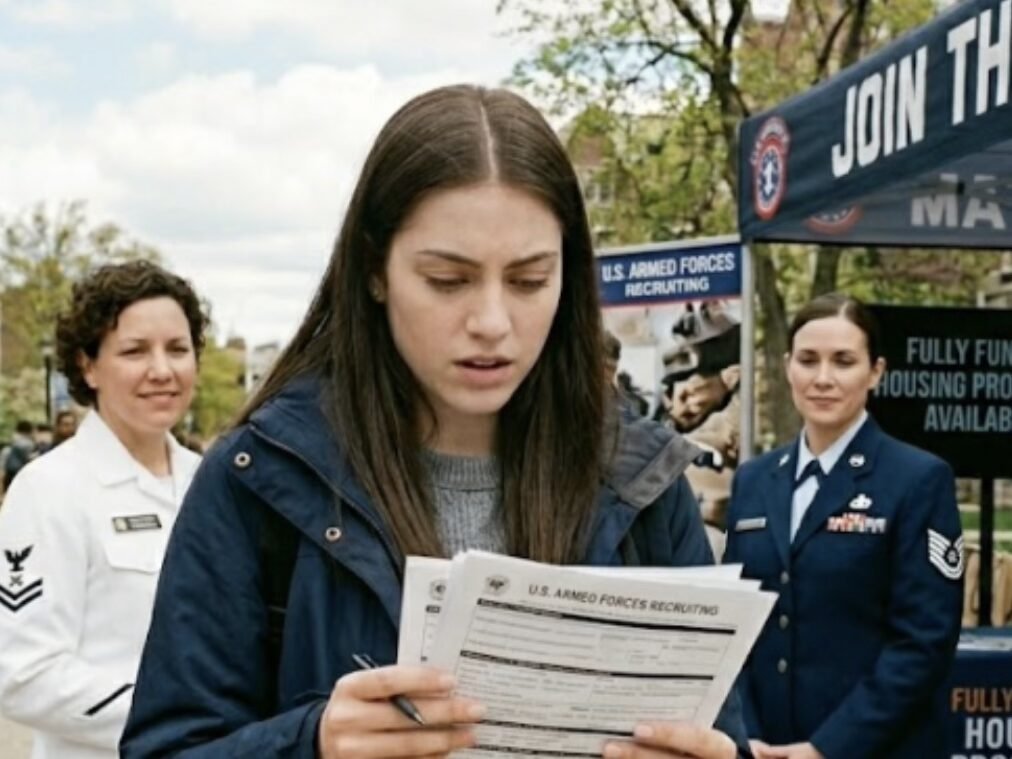
Her escape arrived in the form of a recruitment booth on campus. While her parents preached pacifism, Charlotte found herself drawn to the sharp uniforms and structured promises of the American Armed Forces. She listened intently to the recruiters from the Army, Navy, and Air Force. They spoke of stipends, specialized training, and—most importantly—fully funded housing far away from San Diego.
She picked up the application forms, her heart racing. She needed a next of kin, but her parents were out of the question. Her mind immediately went to her father’s older brother, Timothy.
Uncle Tim was the black sheep of the family—a career soldier who had risen to the rank of Major in the Air Force, stationed near Pensacola. Because of her parents’ disdain for the military, they rarely spoke, but Charlotte remembered a card he had tucked into her hand during a rare visit years ago.
She found it in the back of a junk drawer: a crisp white card embossed with the Air Force logo.
Afraid to use the house phone, she drove to the local mall and found a quiet corner. Her hands shook as she dialled.
“Major Raven’s office, how may I assist you?” The voice was clipped and professional.
“Uncle Tim? It’s… It’s Charlotte. Your niece.”
The voice softened instantly. “Charlotte! Hello. Is everything all right? I’m just finishing up some paperwork.”
“Uncle Tim, I need a way out,” she said, her voice dropping to a whisper. “Things aren’t… they aren’t ‘kosher’ here. Charles is still playing his games, and my parents still see him as a saint. I’m applying for the Army. I need a future, and I need to get away from this house. Can I use your name as my relative and contact?”
There was a brief silence on the other end. “I know my brother can be difficult, Charlotte. And I know how they feel about the uniform. You have my full support. Use my details. And good luck—it’s a brave path you’re taking.”
They spoke briefly of pleasantries before hanging up. For the first time in years, Charlotte felt a genuine smile spread across her face.
That night, she was a ghost in her own home. She ate supper in silence, loaded the dishwasher, and retired to her room, turning the key in the lock. The next morning, she ate a hurried breakfast of bacon and eggs, grabbed her lunch, and headed to campus.
She walked straight to the young soldier at the recruitment desk—the one whose pitch had first sparked her interest. As she handed him the completed forms, a single thought echoed in her mind:
I’m leaving the Kingdom of Prince Charles behind. It’s time to join Uncle Sam’s family.
Liked what you read? click below & Share!