CLICK ABOVE TO LISTEN
Caesar’s Emissary
-Olac the Gladiator
By Samuel
👇 Click to translate:
This story revolves around Olac, a Prince captured, sold into slavery, and trained as a gladiator. He was subsequently presented to Julius Caesar, became a Praetorian Guard, and ultimately served as Caesar’s Emissary to the Scottish Nation. His mission was to broker peace and gain their trust for enlistment into the Roman Army. This is the adventure of a faithful, fearless warrior prepared to perform his duties with honour and integrity. These qualities made him both a wonderful friend and a formidable enemy.
Chapter One: Caesar’s Return
Julius Caesar returned to Rome having subdued most of the British Isles, with one critical exception: the Scots. Scotland, a land of fiercely independent and warring clans, united only when facing a common threat, as they had against Caesar’s legions. It’s noteworthy that Rome never truly bested Scotland. They were a fearsome, awe-inspiring nation whose men loved life, loved women, and loved nothing more than a fight of any kind, anywhere, and anytime. Years later, under another Roman General named Hadrian, a wall would be commissioned across Britain, dividing Scotland from England. This barrier, the famous Hadrian’s Wall, separated the conquered South from the perpetually free North. All Rome truly achieved was the Scots’ gratitude, as they didn’t need to worry about the Romans, allowing them to get on with their favourite pastime: hearty skirmishes between the clans.
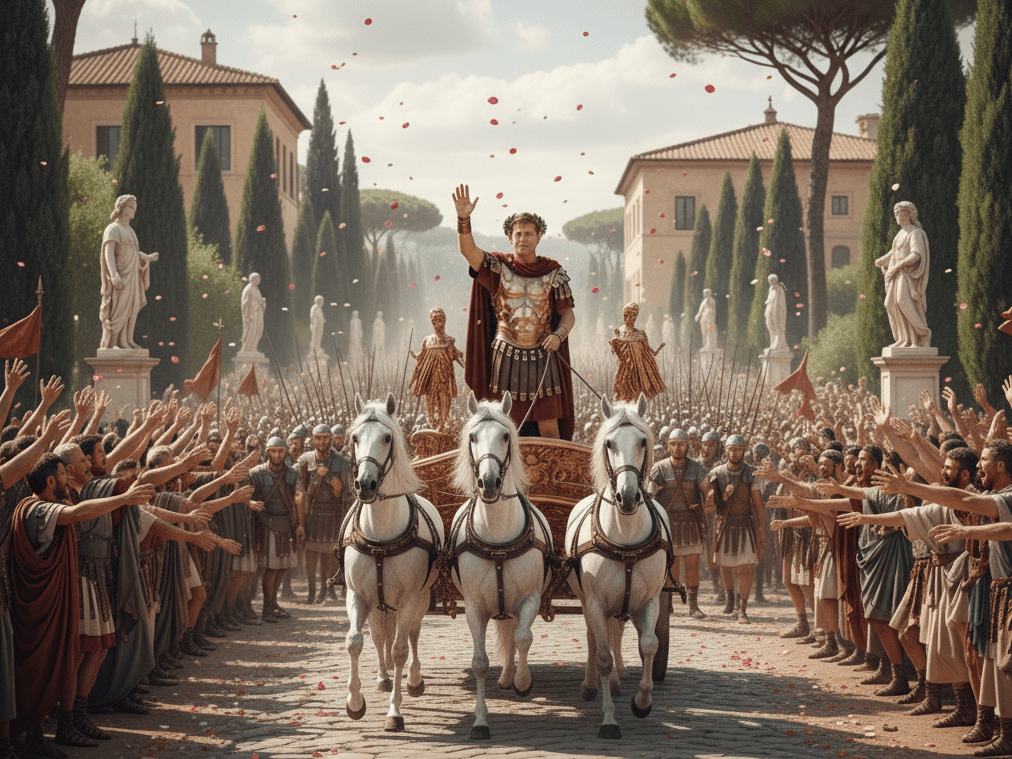
Caesar rode into Rome in full ceremonial military uniform along the Appian Way. He proudly stood on his gold-encrusted chariot pulled by four white Arabian horses. He led his “all-conquering” army, basking in the praise from the Roman crowd. “Hail Caesar, mighty leader of Rome’s Imperial army! Hail Caesar! Hail Caesar!” The cheers echoed all the way up and down the Appian Way. It had been a full three years since they’d last seen their beloved Rome. Though weary and worn from the campaign, they somehow mustered the strength to march cohesively and uniformly in front of this guard of honour presented by the Roman public. History quietly records that Caesar couldn’t stay on longer to try and defeat the Scots because word had been brought to him about an imminent revolt against him by the Senate, led by none other than his close ally, Cassius Brutus. As was customary, he did not go home but rather proceeded directly to meet with the Senate, both to update them and to answer any questions they might raise about his last expedition.
The formalities completed, Caesar started his report. He mentioned that he had opted to avoid sailing from Italy’s west coast to Gaul (present-day France), as originally planned by the Senate, due to the immense logistics required for transferring the large army and all necessary supplies. Instead, they had marched north, crossing the Southern Alps region directly into Gaul. Thus began the planned campaign of subduing the three main target countries: Gaul, Britannia (England), and Scotland. Several senatorial heads nodded in agreement, as there had been concern all along about the initial route switch.
The Gaelic Campaign started with wars fought in the Helvetic region, moving through Celtae (Celtica) on the west and thrusting north towards Belgica (present-day Belgium). Once the tribes of these regions were conquered, the Roman army crossed over the English Channel onto the next leg of their planned campaign. This was Caesar’s second attempt at invading Britannia; the first had failed due to unpreparedness. Due to the large contingency on this second attempt, the Britons did not dare contest his landing.
In Britannia, his army camped in the region of present-day Kent. It was now the winter months, and any further marches were put on hold, as the cold snowstorms made movement almost impossible and very unbearable for man and beast. However, Caesar ensured the time was spent profitably. The soldiers had to clean their military equipment and assemble for inspection every third day. Those whose uniforms and dress were sloppy were immediately placed on night-time guard duty, which was particularly unpleasant as the night chill factor was extremely high. Scouts were also sent out to spy on the land and report back so that Caesar and his generals could strategize for the battles that were anticipated. As spring approached and the snow started to thaw, they prepared to break camp and be on the march at a moment’s notice.
That moment arrived, and within an hour post-assembly, they were on the march. Over the next few months, they met with fierce resistance from various tribes as they fought battles against them. At some point, the Britons realized that resisting as individual armies against the superior military-trained Romans wouldn’t succeed and started amassing themselves as unified forces to try and repel them. The Britons’ new strategy worked for a while, but Caesar, the master strategist, employed the pincer movement and proceeded to conquer areas such as Londinium and all the way up to what was known as The Brigantes. Planning to press further, he encountered the Highlands Resistance (the combined forces of the Scots).
Concurring with his generals, a decision was made to return to Rome. Their combined reasoning was that, from intelligence gathered, there was no profit to be gained in conquering that part of the British Isles. It was a harsh country that had no mines, the land wasn’t good for farming, and there were no possible trade goods. Romans had not yet acquired a taste for what centuries later became Scotland’s famous export, Scotch Whisky. From that point, the return trip was one of securing the Roman garrisons that had been established both in Britain and in Gaul.
The Senate had heard his story and was now abuzz with discussions from the various group alignments. As the discussions abated, Caesar became the focus of their attention. At this point, questions were voiced on a number of issues. Finally, the questions were reduced to one which all seemed to agree upon: “Can Rome mount another campaign, one that would be larger than the last? The basis for this request is that Rome could use such fearsome fighters as the Scots in their armies as they further endeavour their quest to conquer more territories.”
After much debate, no conclusion was reached, so the Senate decided to continue this discussion at a special meeting scheduled for two weeks later. Caesar retired to his villa, his family, a much-needed luxurious bath, and a feast fit for an emperor. A few of his closest friends attended the feast, Mark Antony included. As the party drew to a close in the early hours of the next morning, he indicated to Mark Antony that he needed a word with him. He requested that they meet at the local baths in three days, as he wanted to “unburden” his soul about the Senate’s request. Over the next couple of days, he attended to his private business affairs but also made time to reflect on the Senate’s request. For one, he would not attempt a third trip to the British Isles so soon after this last campaign.
As planned, he met with Mark Antony. At first, it was small talk, as others, whom Caesar had now learned to distrust, were also present. When they finally had some moments alone, Caesar gave Mark his thoughts on the request.
Caesar began: “Firstly, my decision is to allow someone else to go on the third expedition into Britain. While preparations are being made to assemble another large army, requiring at least six legions of seasoned soldiers, I have an alternative proposal for the Senate. My proposal, if successful, would negate the need for another venture to the British shores.”
Mark Antony replied: “Julius, there are still several curious persons present. Let’s retire to my villa up in the hills, and there we can discuss your new proposal.”
On their arrival at the villa, Mark gave instructions to one of his most trusted attendants, a centurion named Felix, to set up a canopy with two recliners about one hundred and twenty pedes away from the villa’s east side. In the afternoon sun, this would be the cool side, as huge trees shaded it.
Caesar’s plan was simple in its makeup, yet it had the element of possible success because it could also be considered preposterous. “Mark,” Julius started, “If Rome could send an emissary, one who is highly trusted by both us and the Scots, and he could meet with their leaders and lay out a strategy whereby they could form an alliance that could be beneficial to both sides and thereby avoid bloodshed.”
“One man!” retorted Mark. “No, Julius, besides the voyage being fraught with many dangers, it would be a Herculean task failing. In fact, does such a man exist?”
Liked what you read? click below & Share!